So, you’re planning a trip to Japan and looking for a quick escape from the neon lights of Tokyo. You’ve probably heard of Hakone, the hot spring town with the pirate ships, the unique black eggs, and those elusive views of Mount Fuji.
Most travellers head there knowing they need to take a train, a cable car, a ropeway, and a boat to see it all. But when they see the total cost of all those individual tickets, the math can get a bit scary.
That is exactly the problem the Hakone Freepass solves: it bundles (almost) all your Hakone tickets into one simple pass. But with the price hike in late 2025, the big question we get asked every day is: Is it still worth it?
Our guide breaks down the cost, coverage, and “hidden” value to see if it’s right for your trip.
Planning Your Own Dream Trip to Japan?
Feeling overwhelmed by the endless options? Let us take the stress out of planning. We design 100% custom itineraries based on your interests, budget, and travel style, helping you discover the Japan you’ve always dreamed of.
→ Find out more about our Personalised Japan Travel Planner
What is the Hakone Freepass?

Put simply, the Hakone Freepass is a comprehensive bundled ticket that grants you unlimited access to eight different modes of transport across the entire Hakone region for either two or three consecutive days.
It is designed to cover every leg of the famous “Classic Loop” sightseeing circuit (more on that later), meaning you can move seamlessly from the mountain railway to the cable car, transfer to the ropeway gondola, and finally board the sightseeing cruise ship without ever needing to purchase individual tickets.
For travellers starting from Tokyo, the pass also includes the base fare for a round-trip journey between Shinjuku Station and Hakone-Yumoto, effectively covering your transit to the destination and your exploration once you arrive.
However, there is a crucial distinction regarding the journey from Tokyo that catches many first-time visitors off guard. The “round trip” included in the pass only covers the base fare for the standard commuter trains, such as the Express or Rapid Express. It does not cover the Limited Express Romancecar.

We like to explain it using an airline analogy: the Freepass provides you with a free “Economy Class” ticket, which gets you to Hakone on a regular train where seating is not reserved and you might have to stand. If you want the “Business Class” experience (specifically the Romancecar with its reserved swivel seats, panoramic windows, and onboard service), you must pay a separate surcharge to upgrade. The pass covers the track you ride on, but the surcharge pays for the luxury seat you sit in.
Beyond the financial savings, the best part of the pass is the sheer convenience it affords you on the ground. Hakone is a region that requires constant transfers between buses, trains, and boats. Without the pass, you would be forced to queue at a ticket machine or counter every single time you switch modes of transport.
With the Freepass, you simply flash your ticket or phone screen at the manned gate and walk straight through. This VIP-style access saves you significant time and mental energy, allowing you to focus on the mountain views rather than fumbling for coins at every stop.
How Much Does It Cost?

Let’s talk about the price, because this is where the real value, or lack of it, starts to show. The pass has a straightforward price based on your departure point.
From Shinjuku (Includes Round-Trip Train from Tokyo):
- 2-Day Pass: Adults: ¥7,100 (~$45 USD) | Children: ¥1,600 (~$10 USD)
- 3-Day Pass: Adults: ¥7,500 (~$48 USD) | Children: ¥1,850 (~$12 USD)
From Odawara (Ideal if you are coming from Kyoto/Osaka):
- 2-Day Pass: Adults: ¥6,000 | Children: ¥1,500
A quick tip for families: The child rate is significantly cheaper than the adult rate, making it an absolute no-brainer for kids.
Again, the pass does NOT cover the reserved seat fee for the Limited Express Romancecar. It covers the base fare only. If you want the luxury seat (and trust us, you do), you must pay a separate surcharge of ¥1,200 each way.
While this might feel like an annoying extra cost, we strongly view it as a small price to pay for the massive upgrade in comfort. For a fee that is roughly equivalent to a cheap lunch, you secure a guaranteed reserved seat, plenty of legroom, and a stress-free start to your holiday, rather than risking ninety minutes of standing on a crowded commuter train.
What is Covered?

The pass gives you unlimited access to eight different modes of transport:
The Hakone Ropeway

This is widely considered the highlight of the entire trip. The ropeway is a gondola lift that disconnects you from the ground and flies you directly over the Owakudani volcanic valley. Looking down at the active sulfur vents steaming below you is a surreal experience, and on a clear winter day, this is where you get that legendary, unobstructed view of Mount Fuji. It connects Sounzan to the lake, and without the pass, this single ride is one of the most expensive individual tickets you would buy.
The Hakone Sightseeing Cruise

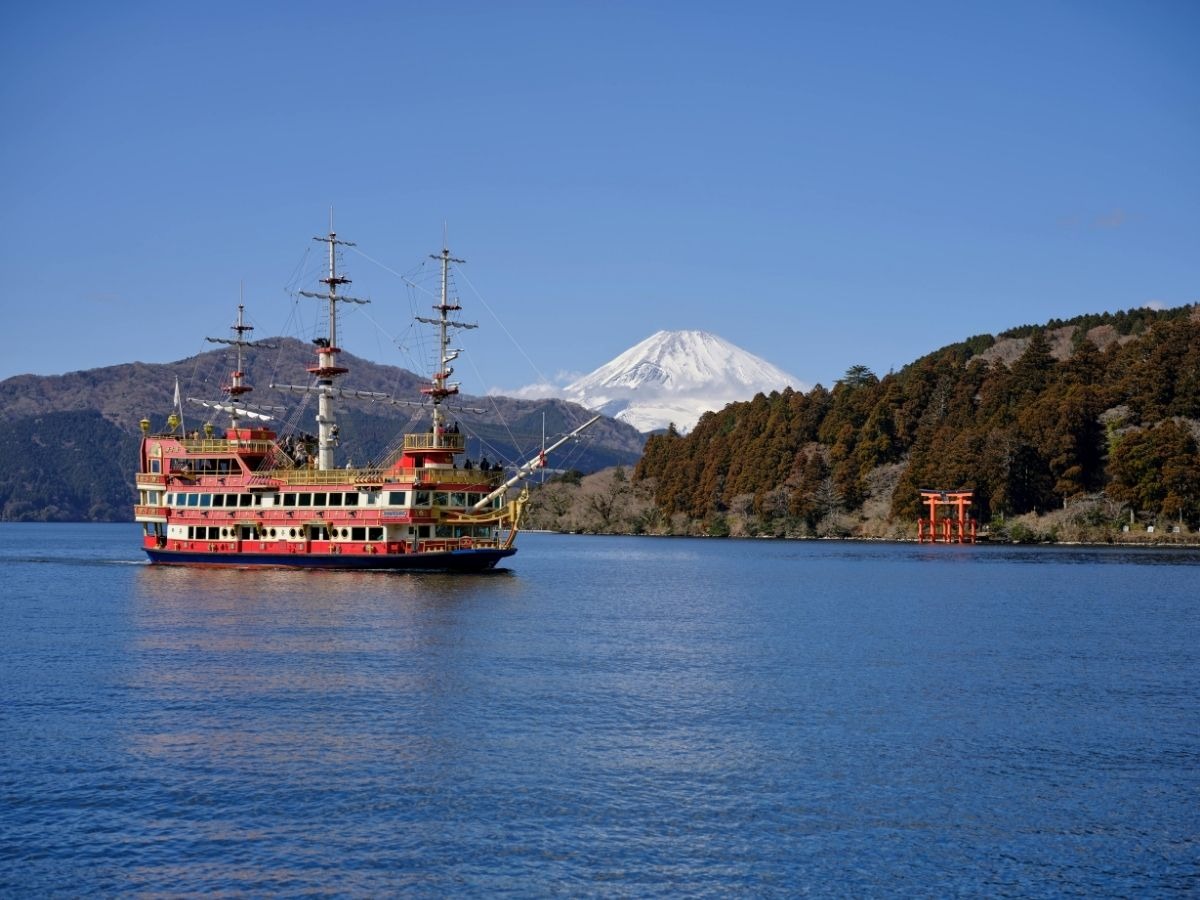
You have likely seen photos of these boats on Instagram. They are decorated to look like giant, colourful pirate ships. We admit it looks a bit kitschy at first glance, but we actually find it to be a genuinely lovely way to cross Lake Ashi. It is the most relaxing leg of the journey and offers a completely different perspective of the mountains.
The Hakone Tozan Train

This is Japan’s oldest mountain railway, and it is a treat for anyone who loves slow travel. The train zig-zags its way up the steep, wooded slopes using a series of switchbacks, meaning the driver and conductor actually have to swap ends of the train several times during the ascent. It is incredibly atmospheric, especially during the hydrangea season in June or the autumn foliage, and it feels like stepping back in time.
The Hakone Tozan Bus
While the train and ropeway get all the glory, the extensive bus network is the workhorse of your trip. It is essential for getting from the stations to the major museums (like the Open Air Museum or the Venetian Glass Museum) and, more importantly, to your Ryokan, as many are tucked away in the hills. The pass allows you to hop on and off these buses freely, which saves you the hassle of calculating fares and finding exact change for every short ride.
The Odakyu Highway Bus
This is a fantastic bonus inclusion that many travellers overlook. The pass covers the specific route that runs out to the Gotemba Premium Outlets. If you are looking to do some serious shopping at one of Japan’s largest outlet malls with a view of Mount Fuji, having this return journey included is a massive perk.
VIP Discounts at 70+ Spots
Most people stop calculating at the transport costs, but the pass also functions as a discount card for the entire region. Simply showing your pass at the ticket counter gets you money off at over 70 local facilities, including hot springs, museums, and restaurants. For example, you get an instant 200 JPY discount at the famous Hakone Open Air Museum and 100 JPY off at the Venetian Glass Museum. These small savings add up surprisingly fast over a two-day trip.
The Japan Adventure You’ve Been Waiting For
Ready to explore Japan without the stress of planning everything yourself? Join one of our expertly-curated small group trips! We blend iconic sights with local experiences and handle all the logistics, so you can simply immerse yourself in the journey.
→ See Our Upcoming Group Trips & Itineraries
Important! What is NOT Covered?
The pass is amazing, but it is not a magic wand. It has some key limits that you need to know about to avoid surprise costs or awkward moments at the ticket gate.
The Romancecar Surcharge
We cannot stress this enough: The Freepass covers the ride, but not the seat. It covers the base fare to get you from Shinjuku to Hakone, but if you want to sit in the reserved, comfortable seats on the Limited Express Romancecar (and trust us, you do), you must pay a separate surcharge. This upgrade costs ¥1,200 each way. Think of it as a mandatory upgrade fee for your sanity and comfort.
The “Rival” Bus Companies (Izu Hakone)
This is a classic trap. There is a rival bus company operating in the area called “Izu Hakone Bus,” and they do not accept the Freepass. Their buses look somewhat similar, but their bus stops usually feature a picture of a lion. To avoid paying double, always look for the orange “T” mark (which stands for Tozan) on the bus stop sign and the front of the bus. If you see the lion, wait for the next one.
Local City Subways
The pass is strictly for the Odakyu and Hakone transport networks. It does not work on the local subway lines in Tokyo or Yokohama, nor does it work on the JR lines (like the Yamanote line). You will still need your Suica or Pasmo card for your city travel before you reach Shinjuku.
The Classic Hakone Loop: How to Explore the Region

We often joke that in Hakone, the transport is the actual attraction rather than just a way to get from A to B. The most popular way to use your pass is by following the classic loop which circles the entire region in a counter-clockwise direction.
You start at Hakone-Yumoto station where you board the Hakone Tozan Train. We absolutely love this charming little mountain railway because it uses a switchback system to zigzag its way up the steep slopes.

From the end of the train line at Gora, you transfer to the Cable Car which winches you up the mountainside to Sounzan. This is just a short connector ride that sets you up for the main event which is the Hakone Ropeway. In our opinion, this gondola lift offers the single best view in the entire region. As you drift over the Owakudani volcanic valley, you can look down at the active sulfur vents steaming below you. On a clear winter day, this is also where you will get that perfect postcard view of Mount Fuji looming in the distance.

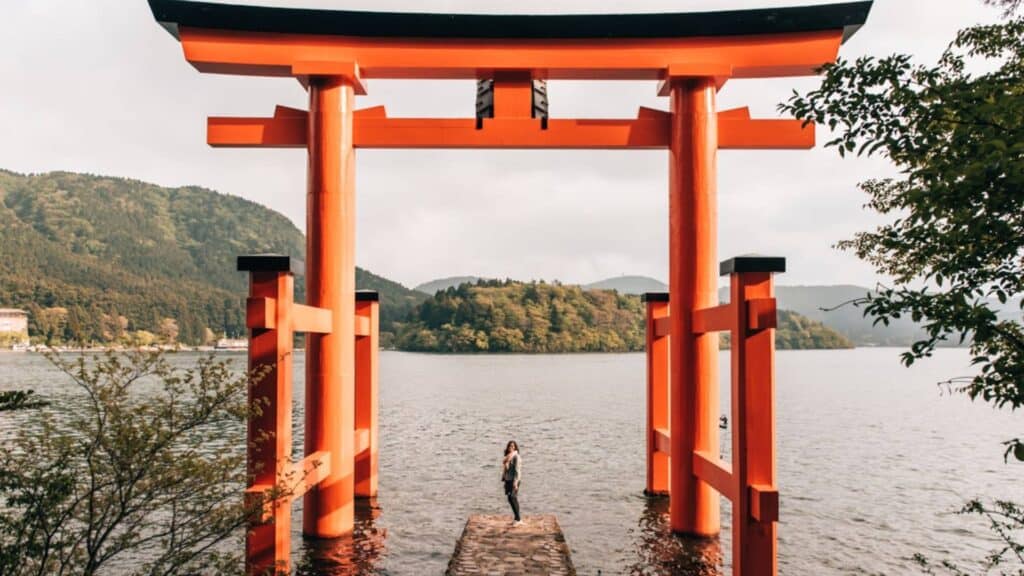
The final leg of the journey takes place on Lake Ashi aboard the Hakone Sightseeing Cruise. You have probably seen photos of these boats which are decorated to look like giant pirate ships. Standing on the deck with the wind in your face as you sail towards the floating red torii gate of Hakone Shrine is a special experience.

Once you dock, you simply hop on a bus that takes you straight back to the station to complete the circle. The beauty of the Freepass is that you can do this entire loop without ever opening your wallet to buy a ticket.
Go Beyond the Guidebook
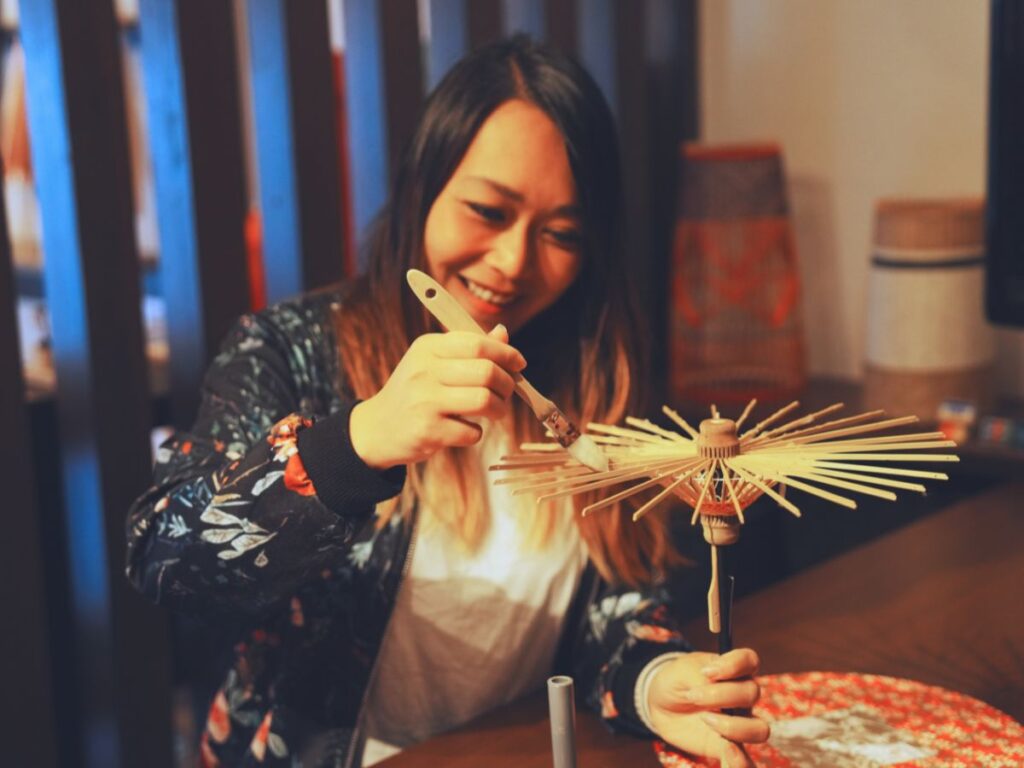
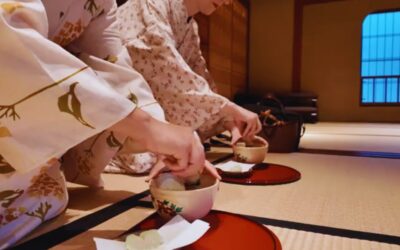
Want to truly connect with Japanese culture? Reading about it is one thing, but experiencing it first-hand is unforgettable. From tea ceremonies to craft workshops, we can help you find and book an authentic cultural experience for your trip.
→ Browse and Book Cultural Experiences in Japan
Hidden Spots in Hakone to Add to Your Itinerary

One of the main reasons we recommend the Freepass is that it gives you the freedom to hop off the train at random stops without worrying about the cost. This flexibility allows you to discover the quiet corners of the region that most tourists completely miss while rushing to the ropeway.
One of our absolute favourite secrets is actually hiding in plain sight at Tonosawa Station. If you get off the train here, you will find the Fukazawa Zeniarai Benzaiten shrine located directly on the platform itself. It is dedicated to a water goddess and tradition says that if you wash your money in the shrine water, it will multiply. We love stopping here because it is incredibly peaceful and feels like a hidden world despite being just steps away from the tracks.
If you are looking for a temple experience that feels genuinely spiritual rather than like a crowded theme park, we insist you skip the main shrines and head to Choan-ji Temple in Sengokuhara instead. The grounds here are dotted with hundreds of stone statues called Rakan, and each one has a unique and often humorous facial expression. It is rarely crowded, and we think it is the most atmospheric spot in the entire area, especially in autumn when the maple leaves turn a brilliant red and cover the stone paths.
For the best views of Mount Fuji, most guidebooks will tell you to fight for a spot near the pirate ship pier, but we think that is a rookie mistake. We always direct our clients to Onshi Hakone Park which sits on a peninsula jutting into Lake Ashi. The view of the mountain from the main lookout point here is far superior to what you see from the crowded tourist traps. You can sit on a bench in silence and watch the ships cross the lake, which is the kind of luxury experience that money cannot buy.
Overwhelmed with Planning?
Take the stress out of your trip with our ready-to-use, 1-day PDF itineraries. Instantly download a plan and start exploring!
Best Food and Culture in Hakone

You simply cannot visit the volcanic valley of Owakudani without trying the famous black eggs known as Kuro-tamago. These eggs are boiled in the natural hot springs which turns their shells a striking charcoal black due to the sulfur reaction. While they look intense and the air around them smells distinctly like rotten eggs, we promise they taste just like a regular boiled egg with perhaps a hint more flavour. The local legend claims that eating just one adds seven years to your life. We always grab a bag of five to share because who couldn’t use a few extra decades?
For lunch, we recommend Ginkatsutei which is famous for its Tofu Katsuni. This dish consists of breaded tofu cooked in a savoury egg sauce and it is honestly one of the best comfort foods we have ever eaten. However, this place is no secret and the line can get ridiculous. We strongly advise you to ignore the standard lunch hour and arrive at 10:45 AM right before they open. Getting there early guarantees you a seat without the frustration of waiting in the cold for an hour which is a common rookie mistake.
If you want to experience the history of the area, you must take a break at Amasake-chaya. This thatched-roof teahouse has been serving travellers for over 400 years and stepping inside feels like walking straight back into the Edo period. They serve a non-alcoholic sweet rice wine called Amazake which is warm, creamy and perfect for a chilly mountain day.
Want to know more about how to explore Hakone? Check out our recommended itinerary:
Is the Hakone Freepass Actually Worth It?
This is the big question we get asked most often. The simple answer is: Yes, if you plan to do the “Classic Loop.”
However, if your plan is to head straight to a luxury Ryokan and sit in a hot spring for two days without sightseeing, it is not a good fit. To help you decide, let’s look at the specific numbers for the most common travel scenarios.
Scenario 1: The “Absolutely Worth It” Trip (The Classic Loop)

You start at Hakone-Yumoto, take the switchback train up the mountain to Gora, switch to the steep Cable Car to Sounzan, transfer to the Ropeway to fly over the smoking volcano of Owakudani, drop down to the lake to board the Pirate Ship cruise, and finally take the bus back to the station. If you were to pay for this adventure leg-by-leg, the costs stack up incredibly fast. Let’s look at the receipt you would rack up with individual tickets (based on approximate 2026 prices):
- Train (Shinjuku to Hakone-Yumoto return): ~2,500 JPY (~$16 USD)
- Hakone Tozan Train (up the mountain): ~800 JPY (~$5 USD)
- Hakone Cable Car (to the top): ~850 JPY (~$5.50 USD)
- Hakone Ropeway (the expensive flight over the valley): ~2,800 JPY (~$18 USD)
- Sightseeing Cruise (across the lake): ~2,200 JPY (~$14 USD)
- Bus (back to station): ~1,000 JPY (~$6.50 USD)
Total Individual Cost: ~10,150 JPY (~$65 USD)
Pass Cost: 7,100 JPY (~$45 USD)
Total Savings: ~3,050 JPY (~$20 USD)
In this scenario, you are saving over 3,000 JPY (about $20 USD) per person. That is enough to cover a nice lunch of soba noodles or a few rounds of local sake. More importantly, you have skipped the ticket queue five separate times.
Scenario 2: The “Definitely Not Worth It” Trip (The Relaxed Onsen Stay)
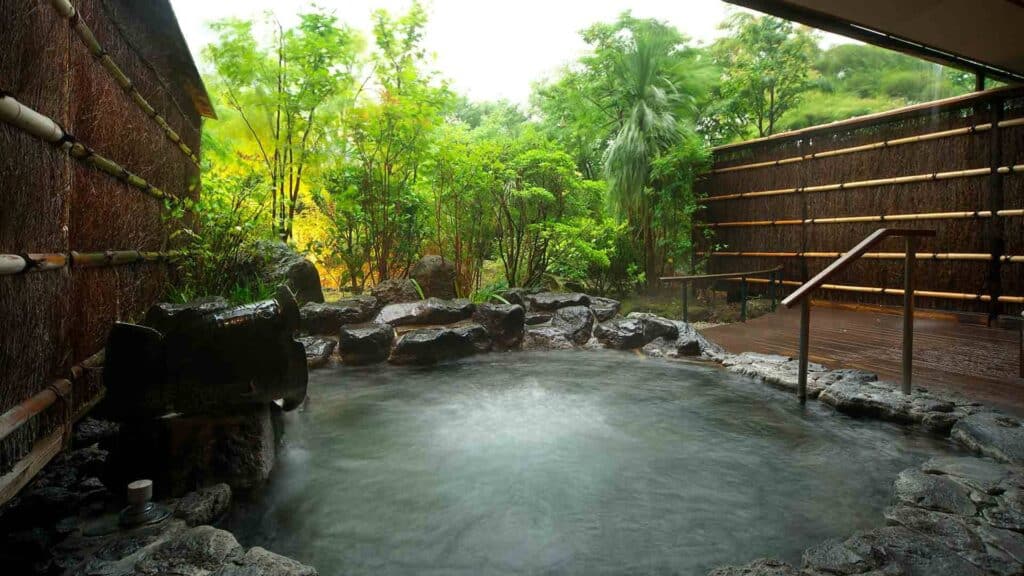
Now, let’s look at a different style of travel. Let’s say your plan is to arrive late in the afternoon, check into a luxury Ryokan near Hakone-Yumoto station, and stay there relaxing for two days. You might only take a short bus ride to a nearby museum before heading back to Tokyo, skipping the ropeway and boat entirely.
- Train (Shinjuku to Hakone-Yumoto return): ~2,500 JPY (~$16 USD)
- Local Bus (short round trip): ~600 JPY (~$4 USD)
Total Individual Cost: ~3,100 JPY (~$20 USD)
Pass Cost: 7,100 JPY (~$45 USD)
Total Loss: -4,000 JPY (-$25 USD)
In this situation, buying the pass is a massive waste of money. You are much better off just using your Suica or Pasmo card to pay as you go. The Freepass is designed for explorers, not for those who just want to stay put and relax.
How to Buy It: Physical vs. Digital
For the vast majority of our clients, we recommend opting for the digital version via the EMot app. The biggest advantage here is security; you cannot accidentally drop a digital ticket while hiking, and it allows you to book that all-important Romancecar surcharge instantly with a few taps. The only real downside is that your ability to travel depends entirely on your battery life, so packing a portable power bank is absolutely essential.
However, if you are a sentimental traveller who loves scrapbooking, you might prefer the physical ticket. You can purchase this in person at the Odakyu Sightseeing Service Centre located near the West Exit of Shinjuku Station. While holding a tangible, stamped ticket feels wonderfully nostalgic and makes for a great souvenir, be warned that the service centre often has long queues in the morning. If you choose this route, we strongly suggest arriving at least 30 minutes earlier than you think you need to.
Hakone Freepass FAQs

Does the pass cover the bus to the Gotemba Premium Outlets?
Yes, it covers the specific Odakyu Highway Bus (W Line) and Hakone Tozan Bus (Lines M, L, G) that run between the Hakone area and the outlets. However, be extremely mindful of the timetables. These buses are far less frequent than the trains (often only once or twice an hour) and the mountain roads get gridlocked with traffic on weekends. We strongly suggest checking the return bus time before you start shopping so you do not get stranded there after dark. Also, check the bus markings carefully, as the Fujikyu buses that also operate in the area do not accept the Hakone Freepass.
Can I just use my Suica or Pasmo card instead?
You absolutely can use your IC card for almost every train, bus and boat in the region now. However, you will pay the full standard fare for every single ride. We prefer the Freepass because it saves you the mental load of constantly checking your card balance and queuing at top-up machines in rural stations that might not accept credit cards.
Does the pass cover the Romancecar to get there?
We cannot stress this enough because it catches everyone out. No, the Freepass only covers the base train fare. You must pay the additional Limited Express surcharge to sit on the Romancecar. We think the comfort is non-negotiable, so please treat that extra fee as a mandatory part of your budget.
What happens if the Ropeway is closed due to bad weather?
This happens more often than you might think due to strong winds or volcanic gas levels. If the Ropeway is suspended, your Freepass is valid on the substitute bus services that run between the stations. We recommend checking the operating status online before you leave your hotel in the morning so you are not disappointed.
Is there a place to leave my luggage?
Yes, and we highly recommend using the Hakone Carry Service at Hakone-Yumoto Station. For a fee, they will send your bags directly to your hotel so you can start sightseeing immediately without hauling a suitcase onto a crowded bus. Most people do not know you can get a small discount on this service just by showing your Freepass, so make sure to flash it at the counter.