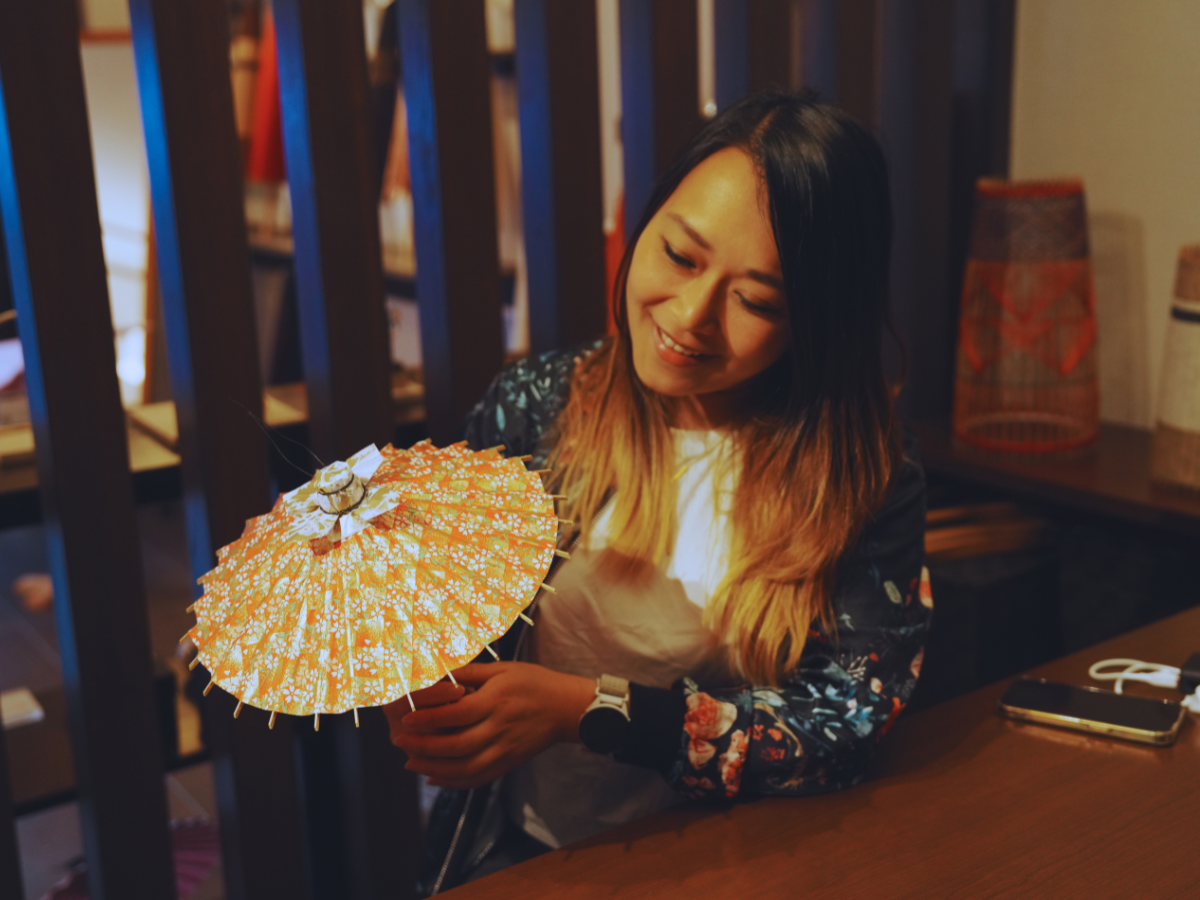
While umbrellas may seem like everyday items, few people realise the sheer beauty and tradition hidden behind the iconic Wagasa, the Japanese traditional umbrella.
The Wagasa is an umbrella made of bamboo and paper that we see often in historical movies and kimono photoshoots, and even if modern umbrellas are much more practical, Wagasa is still used nowadays.

In Kyoto, the art of making Kyo-Wagasa lives on through a hands-on experience that connects you with the craftsmanship, patience, and history of a disappearing tradition. The Kyo in Kyo-Wagasa reflects a style in pattern and crafting that developed in Kyoto, representing the aesthetic style of the people of Kyoto.
From the bamboo core to the washi paper, every part of a Wagasa is made by hand, following techniques that have remained unchanged for centuries. For this experience, you will be crafting a mini Kyo-Wagasa that fits in your suitcase and that will adorn your house whilst reminding you of this tradition.
Key Features of a Kyo-Wagasa Experience:

- Learn about Kyo-Wagasa and the materials used in the experience
- Explore the modern and traditional approaches to the Wagasa technique
- Make your own mini Kyo-Wagasa
Book this and other hands-on Japanese cultural experiences—from dining with sumo wrestlers to forging your own Japanese knife—in the link below.
A Hands-On Journey into Traditional Craft

As I stepped into the quiet workshop, I was greeted by the scent of natural oils, the soft texture of Japanese paper, and the calming clatter of fine tools. Right at the entrance, there’s traditional Kyo-Wagasa on sale, holding tradition, and some more modern approaches to this craft, in the form of lamps and chandeliers.
These modern lamps keep the same structure and materials of the Wagasa, and are a way of continuing the need for this craft and tradition in a household without it being dependent on the use of an umbrella. And if you’re interested in seeing how they implemented modern technology into this craft, you can opt for making your mini Wagasa-style lamp instead!
This workshop knows how to keep tradition alive while also making it reach new purposes, so you can take your time to look around before you begin your experience. This will not be a simple arts and crafts session, but an intimate experience with artisans who have spent years perfecting each stage of the umbrella’s creation.
Before anything else, you will learn about the materials that make Wagasa so unique: thin bamboo ribs, hand-stretched washi paper, natural glue, lacquer, and linseed oil. Each item is chosen with care to ensure flexibility, durability, and elegance. Then, it’s time to begin your journey.
Understanding The Structure Of The Wagasa

Since Wagasa making takes a long time and is an extremely complex process, this workshop does not encompass all of the steps to make a full-sized umbrella. Instead, after I was done with my smaller version of a Kyo-Wagasa, I was able to see a master craftsman work on a real-size one, which allowed me to grasp just how intricate and amazing these pieces of useful art are.
For our workshop, we began by picking the pattern of the Wagasa from a couple of traditional Japanese options. You will be taking it home with you, so feel free to pick what you like the most or what will look best at your house. Then, with the aid of a teacher, I was taught how to glue the paper to the bamboo ribs. This was a fun challenge where I did my very best not to mess up the gorgeous paper.

Then, while the glue dried, it was time to see what real Wagasa making looks like by going on a tour around the workshop. Although it was only a 30-minute tour, we were able to ask questions and see up close the extent of the details and attention that have to be paid to make a perfect Wagasa, ready to be sold.
The Making Of A Real Wagasa

During the tour, you’ll be able to see the Shitago, where the slender bamboo ribs are connected with thread. This skeletal structure determines the umbrella’s final shape and function. You’ll see the structure beginning to take form, showing the first signs of progress, and once it can open and close, it’s time to take a look at the makuwari, where the ribs are carefully spaced.
Patience and precision are key here, as you will see the focus on the master craftsmen working. It is one of the most visually demanding tasks, as the spacing must be even, and they check that with only their eyes and hands, so by the end of the day, their eyesight is quite exhausted.
Next, you’ll see something you now have some experience with, since you just did it on your own mini Wagasa: applying washi paper to the frame in layers.

I was surprised by how swiftly the craftsmen do this; it took me much longer, and my Wagasa was so much tinier! Wagasa making is about more than creating an object; it’s about embracing respect, slowness, and the harmony between people and materials.
Once the umbrella has taken shape, you’ll learn how the outer surface is lacquered and coated in linseed oil to make it waterproof.
Making A Souvenir With A Purpose

To finish, you’ll fold your now dried umbrella along the ribs, tying it gently with string. Your umbrella is no longer just a smaller practical item, but a piece of history you helped bring to life. And as you hold it in your hands, the texture of washi and the soft tension of bamboo will remind you of the slow and beautiful art form you’ve just joined, even if only for a day.
The Craftsman

While many craftsmen connected with their craft through their family and grew up around it, there are also those who discovered it later in life, in pursuit of something more meaningful. At Wagasa, some of the craftsmen mastered Wagasa-making as adults, drawn in by the uniqueness of these traditional crafts.
It’s thanks to her and many other people who are drawn in by the interest in these traditional umbrellas that the continuation of this craft is secured.
Sadly, this is not the case with many traditional crafts in Japan, where the lack of apprentices threatens their survival.
Wagasa Experience FAQs

How much does a wagasa weigh?
Depending on the size, a Wagasa can weigh from less than 100g (0.22 lbs) for small decorative ones, up to 700g (1.54 lbs) for regular-use Wagasa, and up to 4.5kg (9.9 lbs) for those used in parades and special events! Make sure you weigh it in your hand before you buy one.
Are Wagasa really water-resistant?
Yes, Wagasa has a layer of oil treatment that ensures they are waterproof and will keep you safe from the rain. However, higasa (parasol) can have the same shape but not be water resistant, so make sure you ask the staff before you buy one!
What should I not do when handling my Wagasa?
When opening and closing it, you should be careful not to touch the washi (paper) parts, as these are the most fragile. When storing it or putting it away, keep it closed with the head up and the handle area down, which is the opposite of a regular umbrella.
How much does a Wagasa cost?
Depending on the type of materials and on the structure, as well as the pattern, a Wagasa can range from ¥50,000 (250USD) to ¥180,000 (1200USD).
A Piece Of Tradition To Take Home With You

This experience is a rare opportunity, not only to craft something with your own hands, but to understand how Japan’s most ordinary objects are often rooted in extraordinary tradition. You will likely never look at a Wagasa again without remembering the time, effort and attention to detail that was necessary to make it come alive. Nowadays, we see umbrellas as merely disposable items, so this experience is sure to make us look back at tradition once in a while.
In addition to Wagasa, Japan is home to many rich and carefully preserved traditions that you can learn and experience firsthand. Truly live Japan and book a cultural experience with us now.