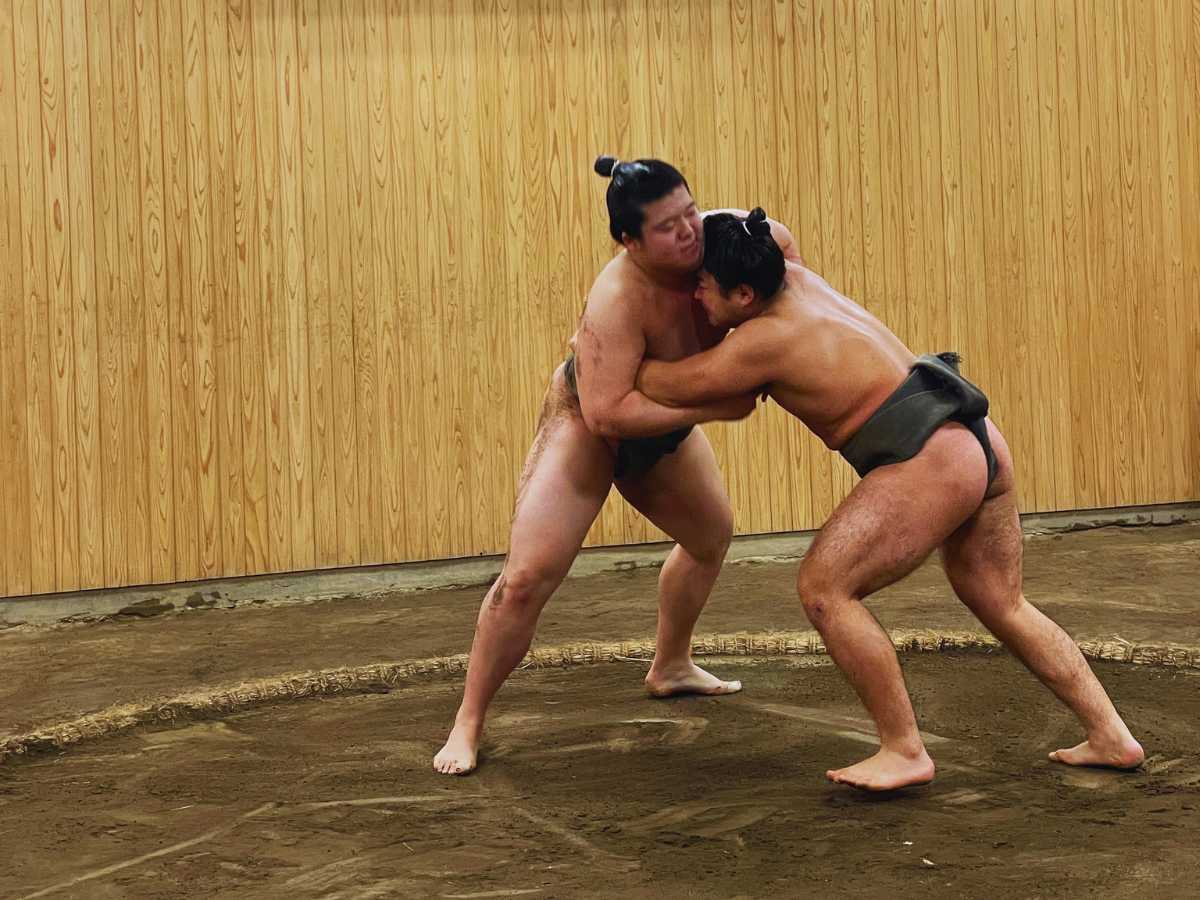

Most visitors to Tokyo see sumo from the outside. By this, I mean that they watch tournament highlights on a screen, maybe spend half an hour at the Kokugikan Museum in Ryogoku, or buy a cool sumo-themed souvenir from one of the stalls in Asakusa. It’s no wonder they come away with a vague impression of sumo being just large men in ceremonial clothing.
A sumo morning practice, asa-geiko, is the opposite of that. It takes place at the heya, the stable where wrestlers live and train full-time. Practice typically starts somewhere between 6:00am and 7:30am and runs for two to four hours. Yes, that means a very early alarm. No, it is not negotiable, and yes, it is worth it.
This is not a performance put on for tourists. It is the actual daily training that the wrestlers undergo every morning, on an empty stomach, in a room that smells of damp clay, sweat, and the distinctive sweet-powdery scent of bintsuke abura (the hair wax that holds the wrestlers’ topknots in place).
Sumo Morning Practice Basics
Before I get to it, know that I will be throwing in a lot of sumo terminologies in the next few paragraphs. But instead of hating me for it, check out our Complete Guide to Sumo Wrestling instead for a quick dive on the history and technical aspects of the sport.
The training is called keiko, and it follows a strict internal hierarchy. Lower-ranked wrestlers begin first, drilling foundational movements while senior rikishi (professional sumo wrestlers) observe and the oyakata (the stable master) watches from his seat. His voice is usually the only one in the room, calling corrections and issuing instructions. Occasionally, you will hear him absolutely bellowing at an apprentice who is not working hard enough. It is a terrifying sound that makes you instantly thankful you only have Slack reminders and urgent emails to contend with when you slack off at work.
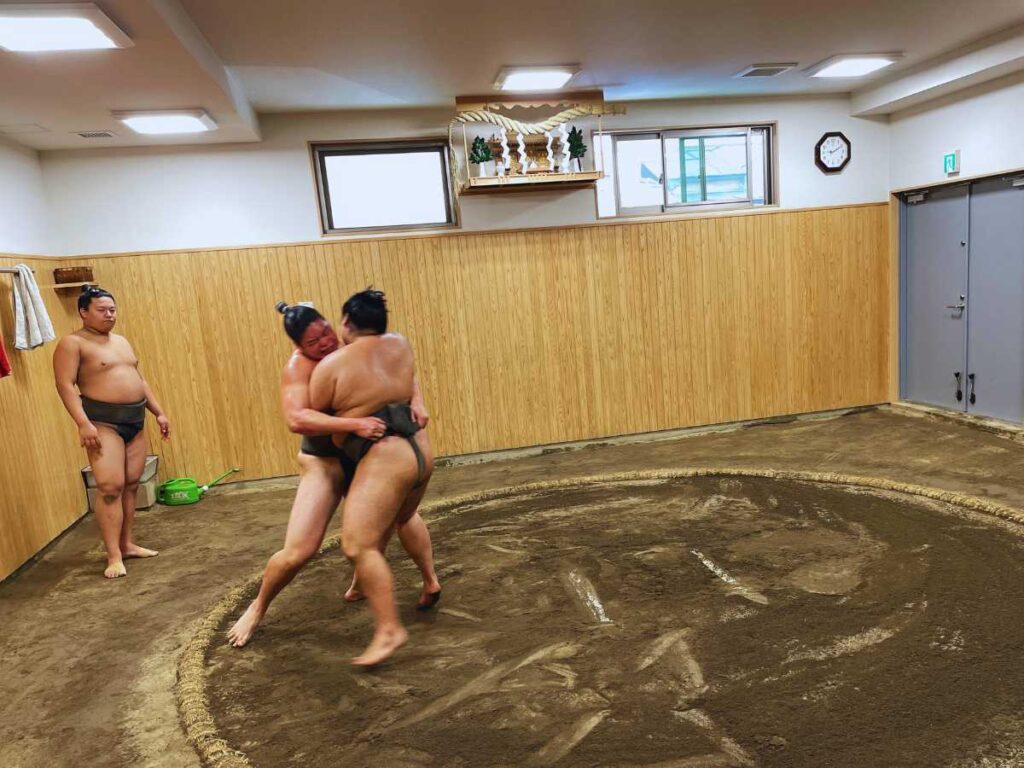
At the centre of the room you will see the dohyo, the clay ring at the centre of the room. You should understand that it is not just a sporting arena but a Shinto ritual object (more on that later).
The heya is also not just a gym that wrestlers commute to each morning. It is their entire world. Lower-ranked wrestlers live in dormitories at the stable, cook for their seniors, clean the building, and organise their lives entirely around the training schedule and the hierarchy above them.
They even do not eat before practice, because they believe training hungry keeps the body sharp and builds the edge that keiko requires. Only after the session does everyone eat, and what they eat is chanko nabe.
The Two Types of Sumo Morning Practice Experience
The Viewing-Only Tour
For this experience, you arrive at a meeting point (most commonly Ryogoku Station on the JR Sobu Line), your guide briefs you on etiquette before entry, and you spend roughly 1.5 to 2 hours inside the stable watching practice from the tatami viewing area, a few metres from the dohyo.
Afterwards there is usually a brief window for photographs outside the stable, a closing talk from the guide, and the tour disperses. Prices run from around ¥12,000 to ¥18,000 depending on the operator and group size. Since it is not too long, this choice is ideal if you have a full day planned afterwards.
The Practice-Plus-Lunch Tour
If you choose this tour, after practice, you stay for chanko nabe served at the stable. In some versions, the wrestlers eat alongside you. In others, the meal is prepared by stable staff and eaten in the training room.
Either way, the shift in the experience is striking. The room that was completely silent an hour before is now full of conversation, and the men who were throwing each other around the ring are now eating across from you.
Things to Know Before Booking a Sumo Morning Practice
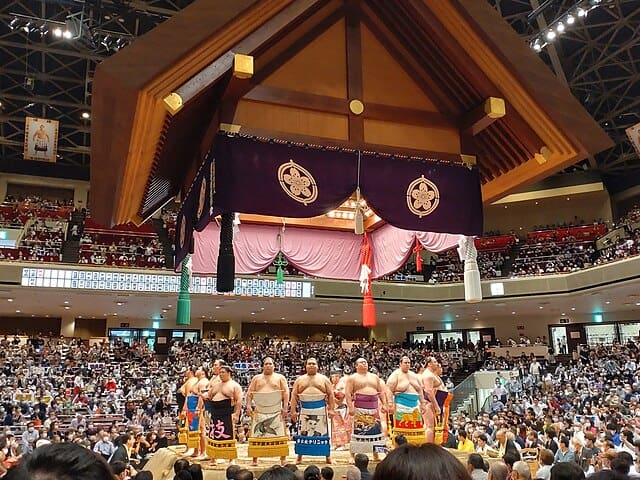
The sumo calendar controls everything. The Japan Sumo Association runs six major tournaments called honbasho) per year, each lasting 15 days. Three are held in Tokyo: January, May, and September, all at Ryogoku Kokugikan. During those tournament periods, morning practice viewing is off the table. The weeks following each tournament also go quiet, as wrestlers typically take seven to ten days off after competing.
The best window for a sumo morning practice visit is the lead-up to a Tokyo basho, when rikishi are deep in preparation and the keiko sessions have genuine intensity. Check the full official tournament calendar at the Japan Sumo Association website and view upcoming tournament dates and ticket information here.
Factor those dates in before you plan a sumo morning practice. Then, book early! We at Flip say this to everyone, and people still email us two weeks out wondering why everything is sold out. Lunch-format tours with capped group sizes fill weeks or months in advance.
If it looks like the timing of your trip would not allow you to attend a sumo morning practice, we have a couple more ideas for experiencing sumo in Japan:
Sumo Morning Practice Etiquette
When you join a sumo morning practice experience, you are observing massive athletes engaging in a highly dangerous physical pursuit, and a momentary lapse in concentration can lead to severe injury. So, it will come as no surprise that you have to follow some very strict rules.
To start with, you must stay silent throughout the entire training session. This does not mean whispering quietly to your travel partner; it means absolute, pin-drop silence. Absolute quiet is a matter of safety rather than just basic politeness, and any chatter will draw immediate, hostile attention. Of course, this also means that there is absolutely no eating and no drinking while you watch.
You also cannot leave the stable once the session begins. There are absolutely no toilet breaks, and stepping outside for a quick breather is simply not an option. You must use the restroom before you enter the building. This absolute lockdown is a non-negotiable condition of the stable allowing visitors.
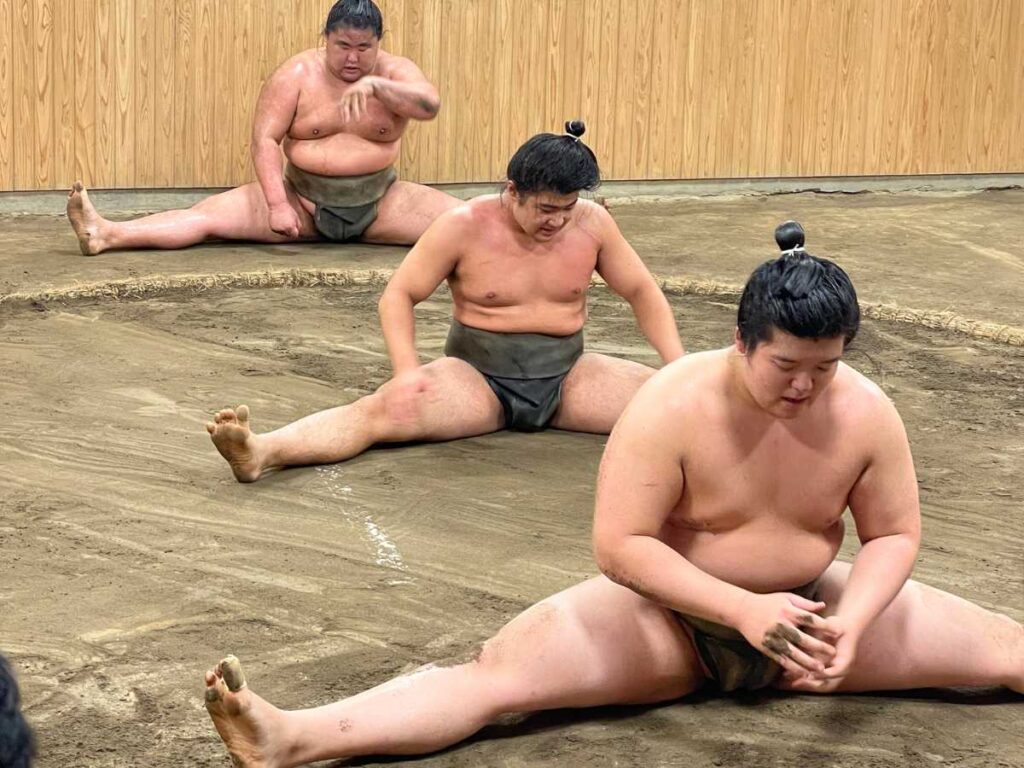
While watching, you will be seated on a thin cushion on the tatami mat floor. You must sit in either seiza or with your legs crossed tightly for up to two hours. Kneeling in seiza for that long will inevitably induce excruciating leg cramps for most Westerners, but under no circumstances can you stretch your legs out, because pointing the soles of your feet towards the sacred clay ring is strictly forbidden.
If sitting on the floor for two hours is physically impossible for you, a few specific experiences do offer very low chairs. However, these are extremely limited, and you absolutely must request one in advance when booking.
As for policies related to taking photos, they vary slightly between stables, but they are universally strict regarding disruptions. Taking pictures is usually permitted, provided you permanently disable your camera flash. You must also make sure to set all electronic shutter noises to silent. Video recording is almost always strictly prohibited to protect the proprietary training techniques of the stable.
Sumo Morning Practice Walkthrough
Arrival and Briefing
Your guide will brief you outside the stable before entry. Listen to every word. The rules are specific: phone on silent before you enter, no talking during practice, sunglasses and hats off inside, no flash and no audible shutter sounds on your camera. If your tour includes audio headsets, your guide can whisper context throughout without breaking the silence. If not, the briefing outside is your only window to ask questions. Use it.
Entering the heya
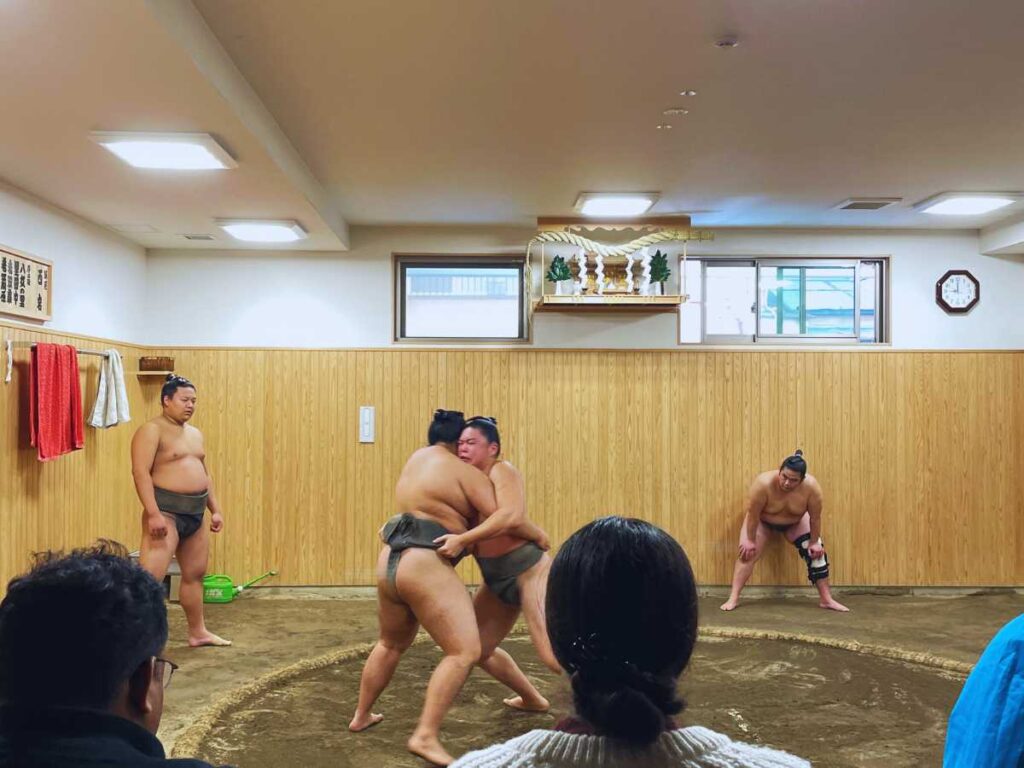
Once your guide is confident that you have understood and will follow the rules, you will enter the heya. The room might be smaller than you expect. The dohyo sits in the centre, with a ring of rice straw bales marking the boundary. The viewing area is a raised platform or tatami section along one wall.
Observing Junior Wrestlers
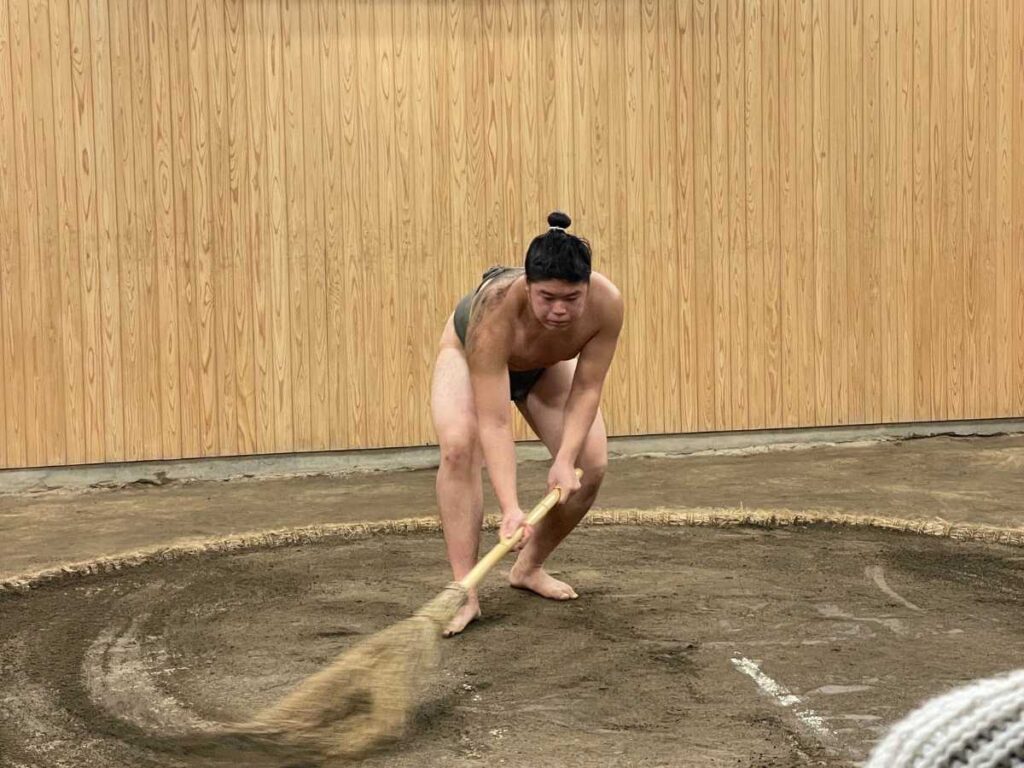
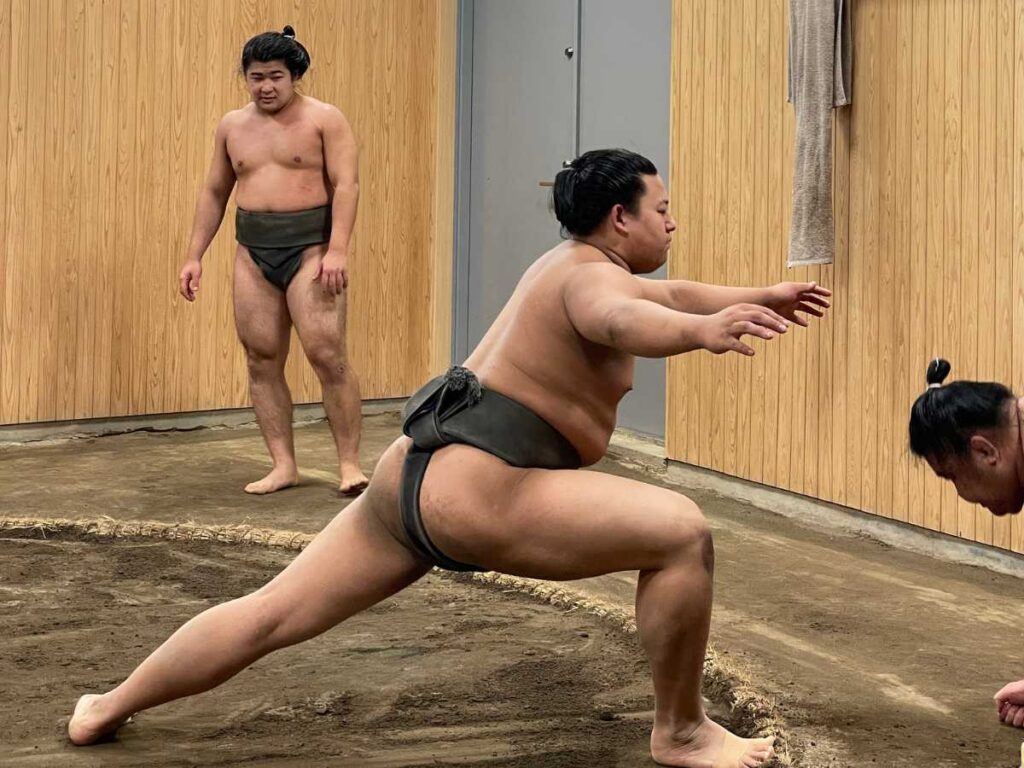
By the time you manage to cross your legs on the tatami mat, the lowest-ranking apprentices would most likely already be drenched in sweat. These are often teenagers who have just left junior high school, wearing black cotton loincloths. They occupy the absolute bottom of the stable hierarchy, and you see this dynamic play out immediately. Before any heavy contact begins, they are the ones fetching water, sweeping the sand flat with handmade brooms, and silently accepting harsh verbal corrections from the older men standing on the periphery.
The apprentices spend an hour locked in endless repetitions of shiko, the traditional leg-stomping exercise. You might think that this is just a casual hamstring stretch, but wait until you see these young men lift their massive legs impossibly high into the air, pause in visible agony, and drive their bare heels into the clay. Doing this two or three hundred times leaves them panting heavily, their skin coated in sweat and sand.
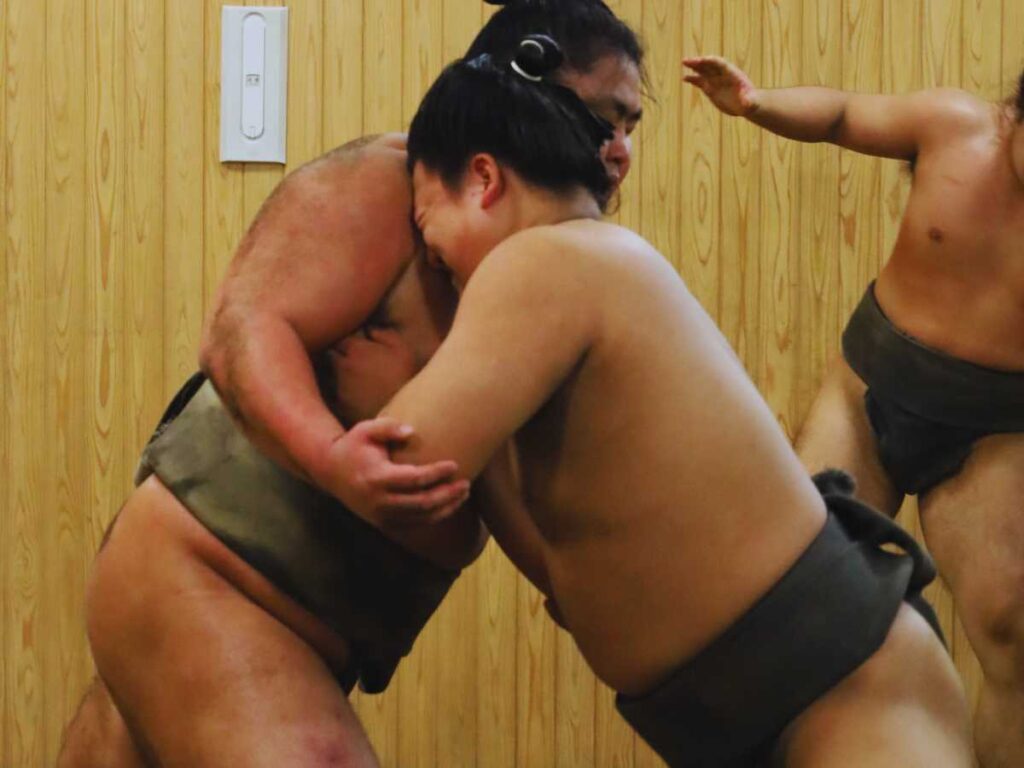
When they move into the collision drills, or butsukari geiko, the reality of their training can become uncomfortable to watch. A slightly older wrestler will plant his feet firmly in the dirt, acting as a human wall. The junior apprentice must charge into his chest at full sprint, attempting to push the heavier man across the ring. When the junior wrestler inevitably collapses into the dirt from pure exhaustion, he is not given a break. He will need to charge again until he physically cannot stand.
The Sekitori Arrive
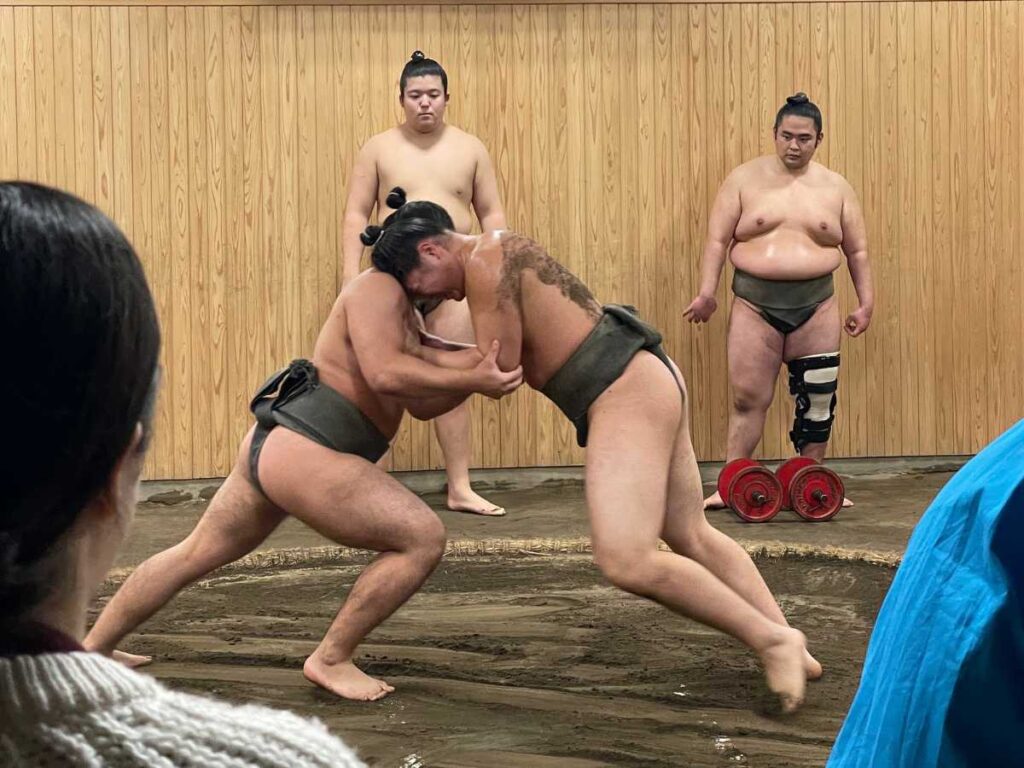
The entire atmosphere of the room shifts the moment the senior professionals, known as sekitori, make their entrance. You can instantly spot the difference in status. These men wear pristine white silk loincloths, their hair is elaborately styled into the traditional topknot, and their physical sheer mass dwarfs the teenagers who were just bleeding in the dirt.
The core of their morning is the moshi-ai, a ruthless winner-stays-in sparring format. Two men weighing well over one hundred and fifty kilograms each crouch at the starting lines. Then, they touch their fists to the dirt and stare each other down in complete silence. The tachi-ai, or initial charge, then erupts from a dead standstill. The sound of two massive bodies colliding at top speed is, I guarantee, louder than you are expecting. This always catches our guests off guard.
Keep your eyes peeled, because a match can end in seconds. The winner remains standing in the centre while the next challenger scrambles into the dirt immediately to deny him a single second of recovery time.
Your immediate instinct as a spectator is to gasp loudly or applaud a spectacular throw. But remember, you have to bite your tongue and swallow that reaction whole if you want to continue watching the experience.
End of Experience for Viewing-Only Guests
There is usually a brief opportunity for photographs outside the stable, and your guide gives a closing talk on the ranking system and career structure. Unless you already have other plans, stay in Ryogoku and visit some of the recommendations in our Ryogoku area guide:
Chanko Nabe Lunch at the Stable
For lunch-format tours, guests will have the pleasure of seeing the focused tension of the geiko lift, replaced by a more informal and warm atmosphere over the ultimate sumo wrestler meal: chanko nabe.
It is a wide pot of broth loaded with chicken or fish, tofu, cabbage, daikon, and whatever else the stable is cooking that day. No two stables make it identically. The broth is rich but not heavy and (my favourite part) the portions are not modest. You will be sitting on the same tatami where you just watched serious men do serious work, eating the food that fuels them through it.
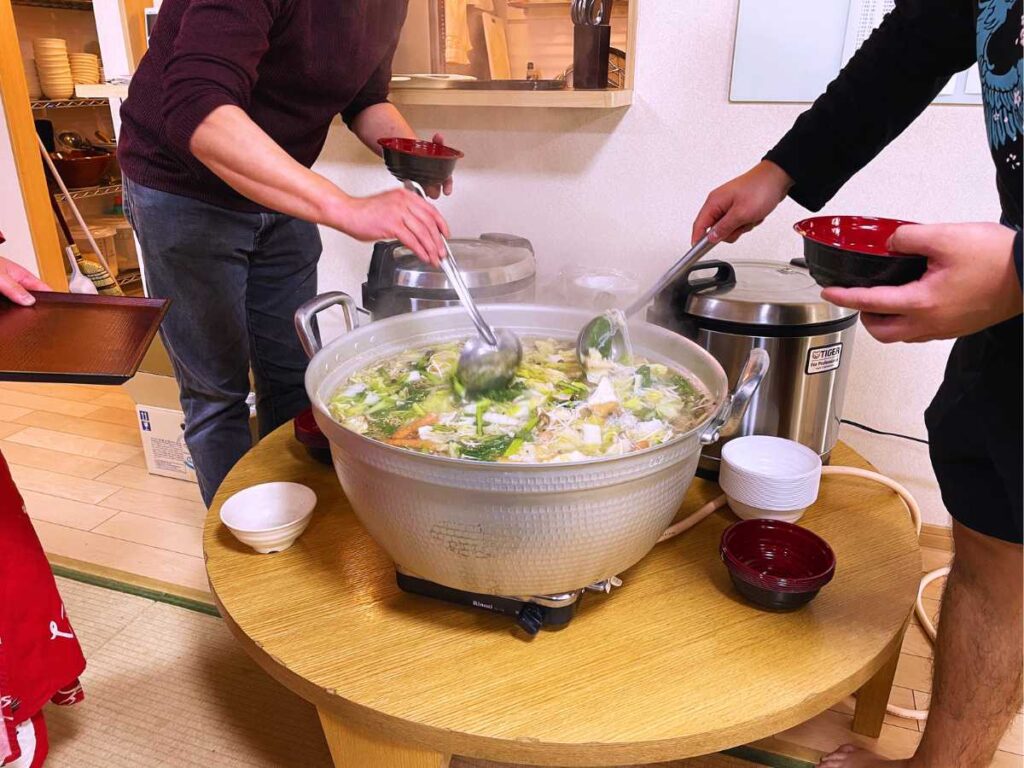
The post-practice interaction with wrestlers varies. Sometimes it is a real conversation through your guide. Sometimes it is photographs and a handshake. After all, these are not people whose working day is finished, and they have just come off hours of training on an empty stomach.
To cap off the experience, how about booking a guided walking tour of the area? Our local experts can walk you through the neighbourhood, explaining the history of sumo and its ties to the district.
Sumo Morning Practice FAQs
Can you watch sumo morning practice for free in Tokyo?
Yes, at Arashio Beya in Nihonbashi, through street-facing windows. But you should remember that the schedule may change at the last minute, and you won’t have a guide explaining what is happening. For guaranteed access inside a heya, a guided tour is the only dependable route.
What is chanko nabe?
It is the daily meal of sumo wrestlers! Chanko nabe is basically a large hotpot stew with protein, vegetables, and noodles, served with rice. Even if you don’t attend a sumo morning practice, you can eat it at restaurants throughout Ryogoku.
Can children attend?
A few tours do accept children from a certain age. But remember, the requirement is complete silence for the full duration of up to two hours. Be honest with yourself about whether that is realistic for your little ones before booking. If not, I consider booking the dedicated Sumo Meal Experience instead, as it is significantly more relaxed.
What should I wear?
You must dress a bit conservatively. This means no shorts, no sleeveless tops, and absolutely no hats or sunglasses worn inside. You are entering a traditional living space and a sacred Shinto training ground, not a holiday resort. You also need to wear clean, presentable socks, because stepping barefoot onto tatami mats is considered incredibly unhygienic and highly offensive in Japan. Wear loose trousers that allow you to comfortably sit cross-legged on the floor. Also, make sure to wear easily removable footwear, because you have to take your shoes off immediately at the entrance, and fumbling with complicated laces while holding up the line is not how you want to start the day.
Is morning practice available all year round?
No, it is not. A lot of travellers mistakenly assume stables are open to visitors 365 days a year. As I mentioned earlier, stables are strictly closed to the public during the 15 days of a grand tournament, and during the immediate week of rest following a tournament.
What is the most important thing to keep in mind when observing a morning sumo practice?
We get asked this constantly and it always comes down to two things: the absolute silence and the floor seating. You must be mentally and physically prepared to sit cross-legged on a hard tatami mat for up to two hours without speaking, eating, or drinking. Again, this is not a casual tourist show.
How much does a sumo morning practice tour cost?
Prices vary depending on the stable, the group size, and if you are including the chanko nabe lunch. Generally, you can expect baseline pricing to start at around 90 USD for a standard viewing tour. Because availability is incredibly tight, I highly recommend that you get in touch with us right away to secure accurate pricing and availability for your specific travel dates.