
There’s a patch of cosmos growing wild along the river near my apartment in Yokohama. It’s just a strip of pink and white someone probably planted years ago that the whole neighbourhood now treats as its own attraction as soon as the seasons turn.
Cosmos in Japan actually start blooming up north, with Hokkaido’s fields seeing them as early as August, then the main wave hits Kanto and Kansai from late September through November, with Kyushu blooming on a similar timeline a little further south.
If you’ve spent any real time here during those months, I’d put money on you having walked past a patch just like mine, maybe heading out from your accommodation for a day of sightseeing, and paused for a second to admire these tiny pink flowers.
They look almost too frail to be growing on their own, with thin stems and papery petals that look like they need a fair bit of fussing over. I remember thinking exactly that the first time I noticed them, just some pretty wildflower that had wandered into a gap in the pavement. Then I saw an actual field of them, thousands stretching out until the colour just became the horizon. That’s when it made sense why locals look forward so much to these tiny flowers, even calling them akizakura, autumn’s cherry blossom.
So, if you’re in Japan this time of year and all you get is the odd patch by a station or a canal, go ahead and enjoy it, it’s genuinely lovely on its own terms. But if you want to know why locals actually build a day around seeing cosmos flowers, here’s where to go.
Where to See Cosmos Flowers Near Tokyo
Hitachi Seaside Park
![Hitachi Seaside Park [Guide to Cosmos in Japan (When and Where to See Them in 2026)]](https://flipjapanguide.com/wp-content/uploads/2026/09/1-1-1024x768.jpg)
Photo: Σ64 / Wikimedia Commons (CC BY 4.0)
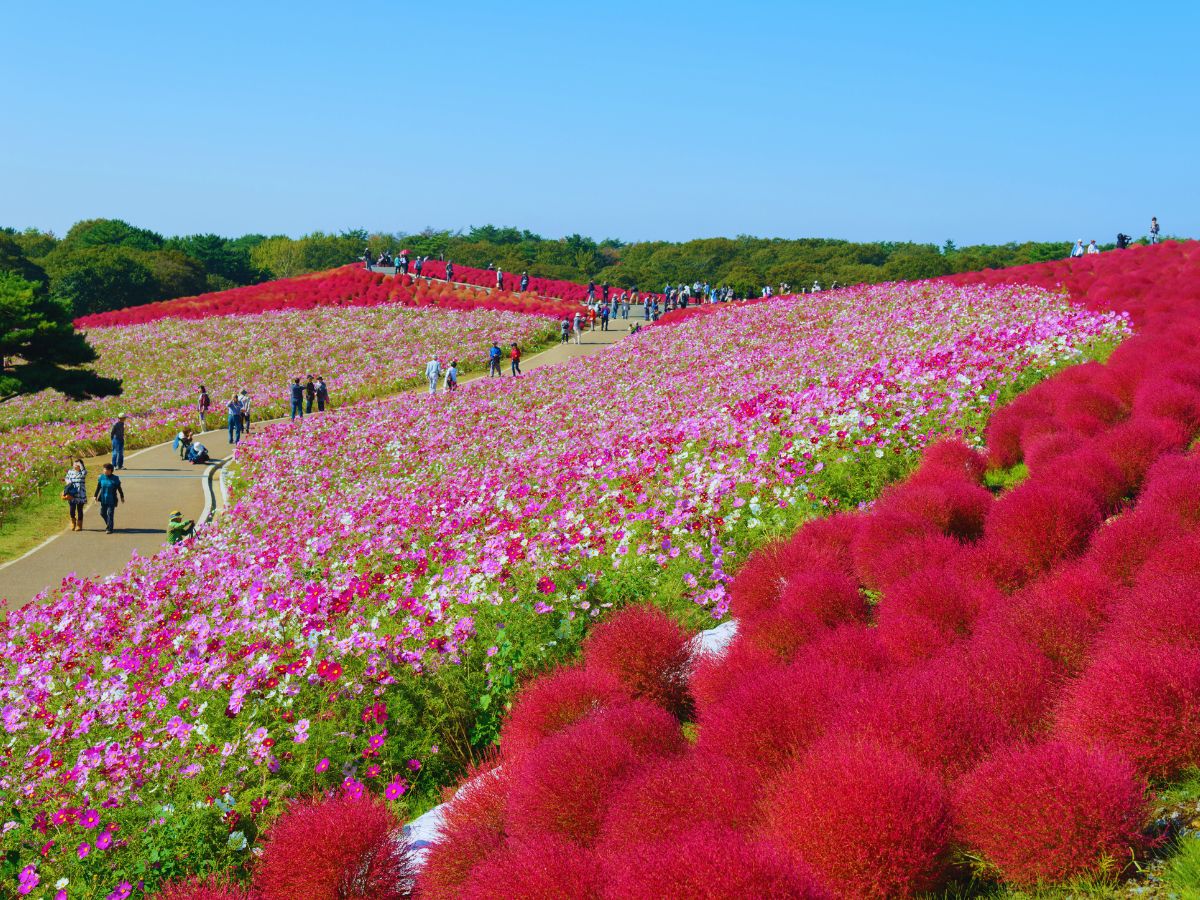
Miharashi Hill in Hitachi Seaside Park carries about 2.5 million or more cosmos yearly (yes, that’s an actual number the facility issued), sharing the slope with red kochia that usually peaks in the back half of October, and the two together turn the same hill from pink and white into a deep red carpet within a couple of weeks.
If you’ve done any research into seeing flower fields in Japan, I’ve no doubt you’ve come across photos of Hitachi Seaside Park. I even vaguely remember the kochia fields being so prominent on social media a few years back. But those photos undersell how big this field is until you’re standing in the middle of it. On a side note, with so many flowers surrounding me, it was also here that I realised cosmos have this faint, slightly bitter scent, nothing like sakura’s sweetness.
And you may be there mainly for the cosmos, but your ticket buys you a lot more than one hillside. The park is hundreds of hectares, after all. There is a cycling course with rental stations dotted around, including tandem bikes and kids’ seats, so you’re not stuck walking the whole way. For 600 yen, you can also get a one-day pass for the rather charming Seaside Train, which loops between the different areas.
I know hundreds of hectares is a lot, so thank God nobody’s forcing you to see all of it. But if you’re already there this time of year, I’d also point you towards Pleasure Garden, a proper little amusement park inside the grounds with a Ferris wheel and a roller coaster. There’s a forest athletics zone too, if you’ve got kids who’ll tire of flowers after twenty minutes.
- Getting there: About 90 minutes via the JR Joban Line limited express (Hitachi or Tokiwa) from Ueno or Shinagawa to Katsuta Station, then a short bus ride to the west gate.
- Entry fee: 450 yen for adults (high school age and up), 210 yen for 65 and over, free for junior high age and under.
- Location: Hitachi Seaside Park on Google Maps
Showa Kinen Park
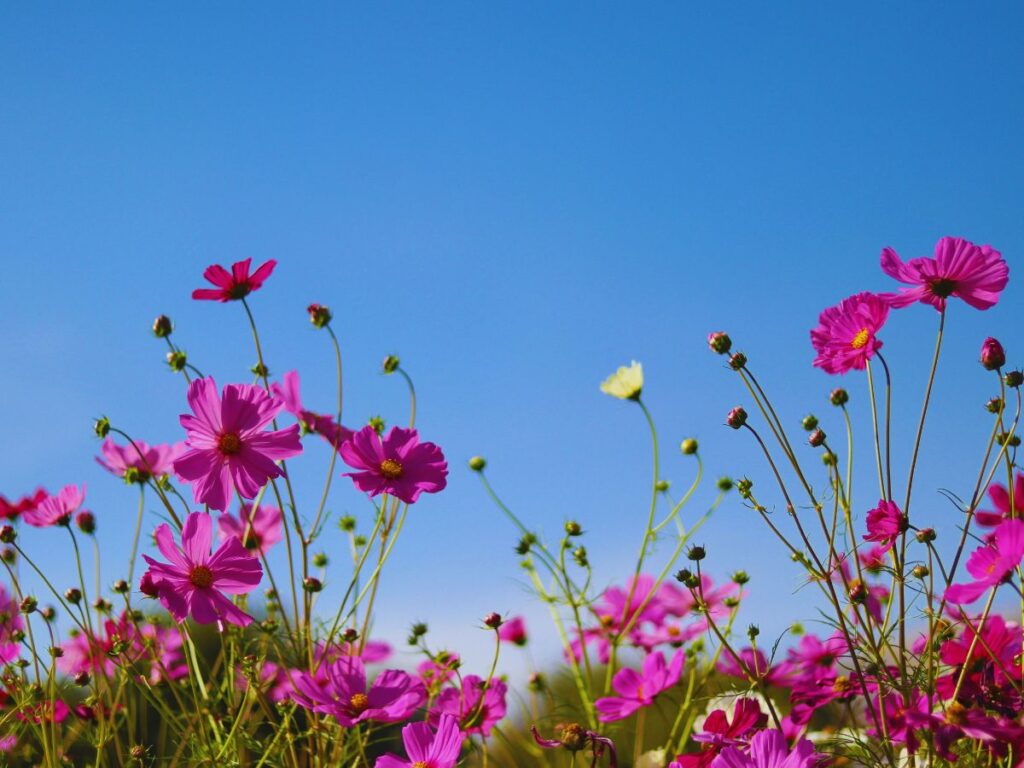
This one often gets called Tokyo’s biggest cosmos display. It earns that name because the park actually has three cosmos areas. Hana no Oka blooms first, from around September, with kibana cosmos, the yellow variety. Minna no Harappa has the main pink and white “Sensation” cosmos, peaking in October, right where most of the festival photos come from. There’s also a mixed flower bed nearby that the park calls the Bouquet Garden, with about twenty species sown together, including cosmos, named because apparently every angle looks like a ready-made bouquet.
The ginkgo avenue running alongside these fields turns gold at roughly the same time the cosmos hit their tail end in late October, so you can walk from pink and white straight into a wall of yellow autumn leaves without planning two separate trips. There’s also a stand of fragrant olive trees, kinmokusei, scattered through the park that bloom around the same window.
- Getting there: Take the JR Chuo Line to Tachikawa Station, then it’s a short walk or bus ride to the Showa Kinen Park entrance.
- Entry fee: 450 yen for adults (high school age and up), 210 yen for 65 and over, free for junior high age and under.
- Location: Showa Kinen Park on Google Maps
If you’d rather not plan a whole trip around flower timing yourself, we can build a personalised Japan itinerary for you, timed around exactly what you want to see.
Where to See Cosmos Flowers Near Kyoto and Osaka
Awaji Hanasajiki
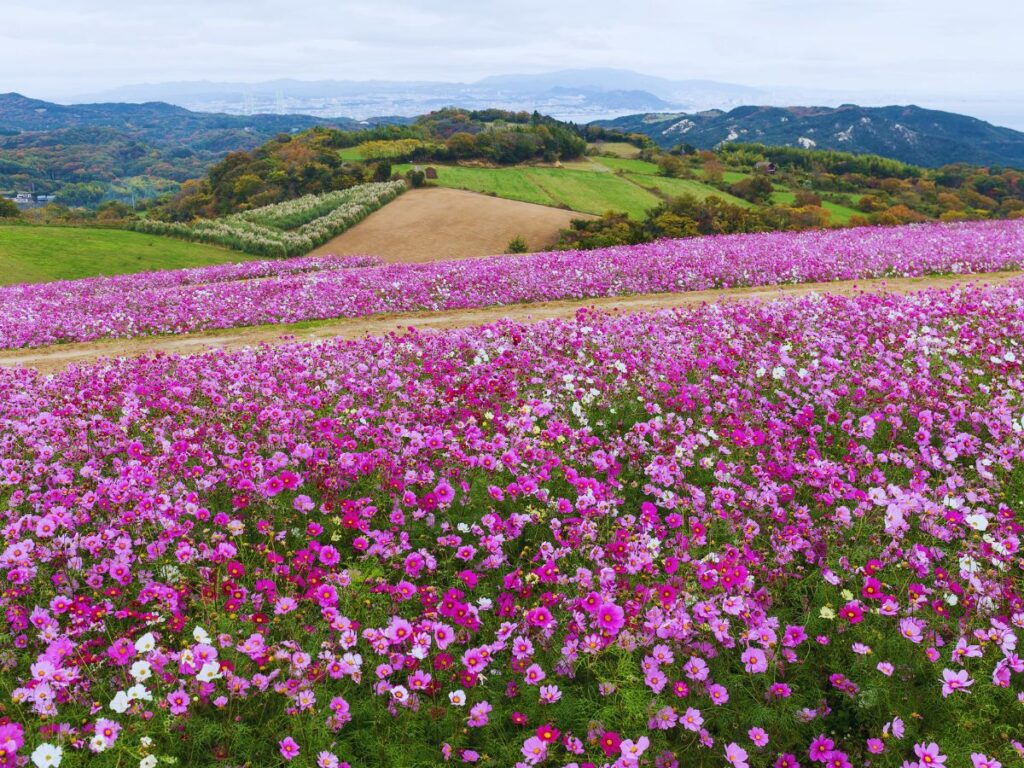
Awaji Hanasajiki sits on a hilltop on Awaji Island, so it is at least a half-day trip of its own rather than a quick add-on to a Kyoto or Osaka day. Cosmos season here usually runs mid-October into early November, and from the top, you’re looking down at the Akashi Kaikyo Bridge and the whole stretch of the Seto Inland Sea, which is most of the reason people bother making the trip out here in the first place.
If your trip happens to be in October, you should also remember that that is when the island’s onion harvest is winding down. Awaji onions are known across the country for being sweeter than most, and roadside stands and local restaurants nearby lean into that hard this time of year, with everything from onion tempura to onion soup.
If the view from Awaji Hanasajiki has you wanting more of that coastline, Hiroshima’s Miyajima island sits on the same Seto Inland Sea, with the “floating” torii gate of Itsukushima Shrine. Peace Memorial Park nearby often has its own seasonal flowers blooming, too. Let our expert local guides show you around with a customised and private Hiroshima tour.
- Getting there: Catch an express highway bus from Maiko Station (or Sannomiya in Kobe) across the Akashi Kaikyo Bridge, and get off at Higashiura Bus Terminal (about a 15-minute ride). From there, it’s about a 10-minute drive or taxi ride straight up to the park (the most practical choice).
- Entry fee: Free
- Location: Awaji Hanasajiki on Google Maps
Hannya-ji Temple
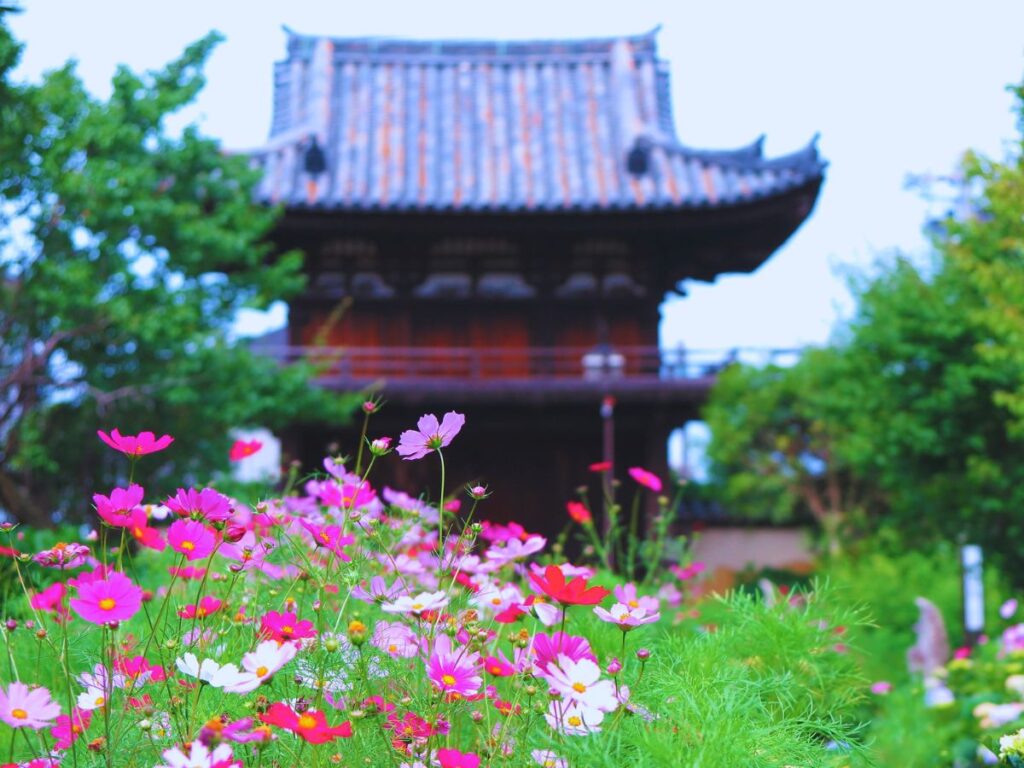
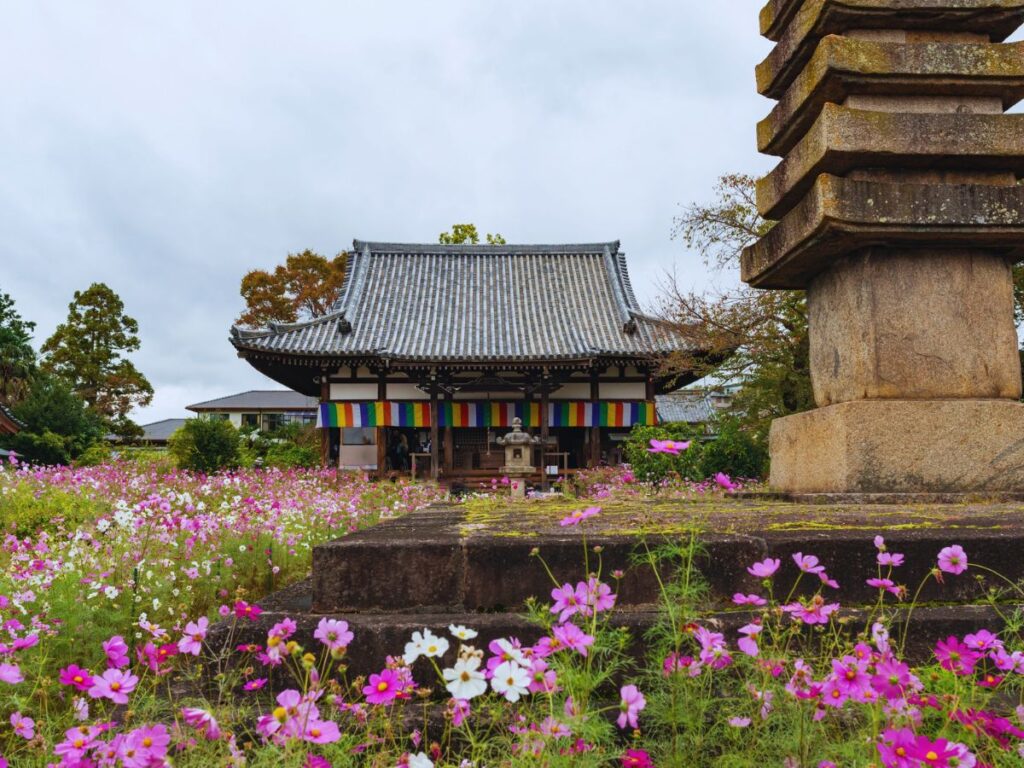
You’ve read that right. A temple has somehow made its way into this list of mostly parks and fields. In its defense, it is otherwise known as the cosmos temple. The grounds feel a bit rough around the edges compared to Nara’s more popular Todai-ji, but just as beautiful.
The cosmos here grows right up against stone Buddha statues, which make for some stunning photos. Since the field here is smaller than the others previously mentioned in this list, you can add a visit to Hokkiji, a UNESCO site with a back field of cosmos that is lesser known and therefore gets smaller crowds.
- Getting there: Take the bus from JR Nara Station or Kintetsu Nara Station to the Hannya-ji stop, then a few minutes on foot.
- Entry fee: 500 yen for adults.
- Location: Hannya-ji Temple on Google Maps
Expo ’70 Commemorative Park
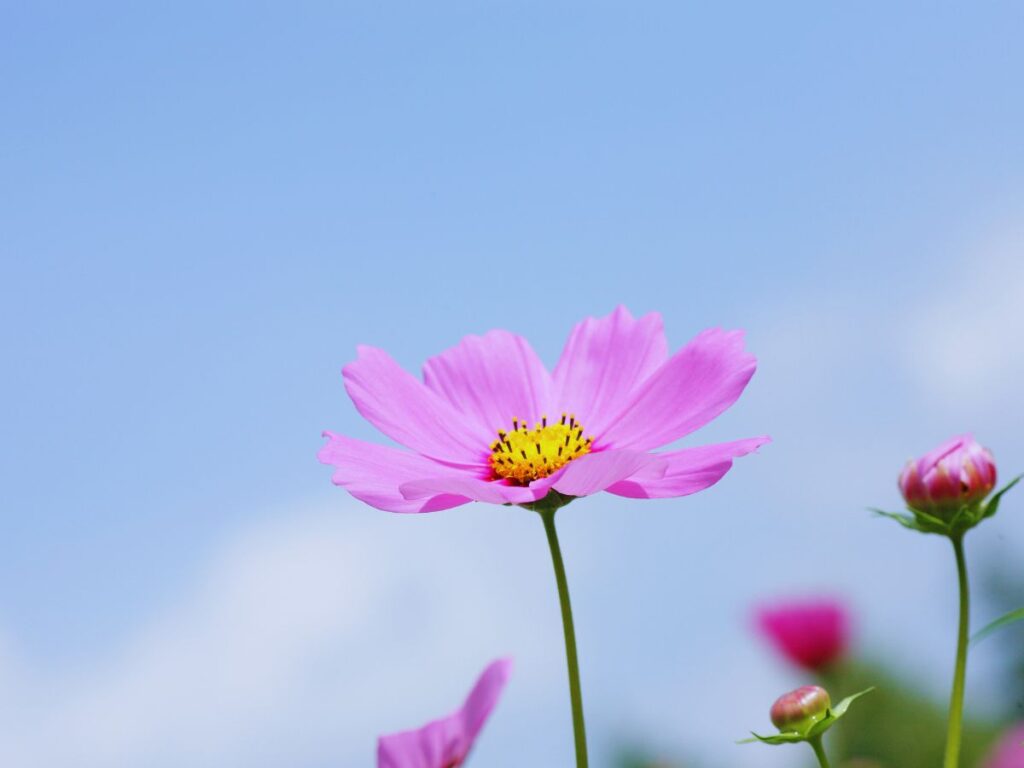
This is the leftover site from the actual 1970 World Expo, built around Okamoto Taro’s Tower of the Sun. The Cosmos Festa often runs from mid-October to early November. Around the same time as the festa, kochia bushes start turning red.
If coming for the cosmos flowers, it might be better to plan to spend a full day in the area. You can book ahead to actually climb inside the Tower of the Sun and see the golden mask that used to sit on top of it during the original expo. Right outside the park gates is EXPOCITY, a shopping and entertainment complex with Nifrel, an aquarium-meets-zoo hybrid that gets visitors closer to the animals than most places allow, plus a cinema and enough restaurants to sort lunch (or even dinner).
- Getting there: Take the Osaka Monorail to Koen-Higashiguchi or Bampaku-Kinen-Koen Station, both drop you right at an entrance.
- Entry fee: 450 yen for high school age and older.
- Location: Expo ’70 Commemorative Park on Google Maps
Popular Spots to See Cosmos in Kyushu and Hokkaido
Uminonakamichi Seaside Park
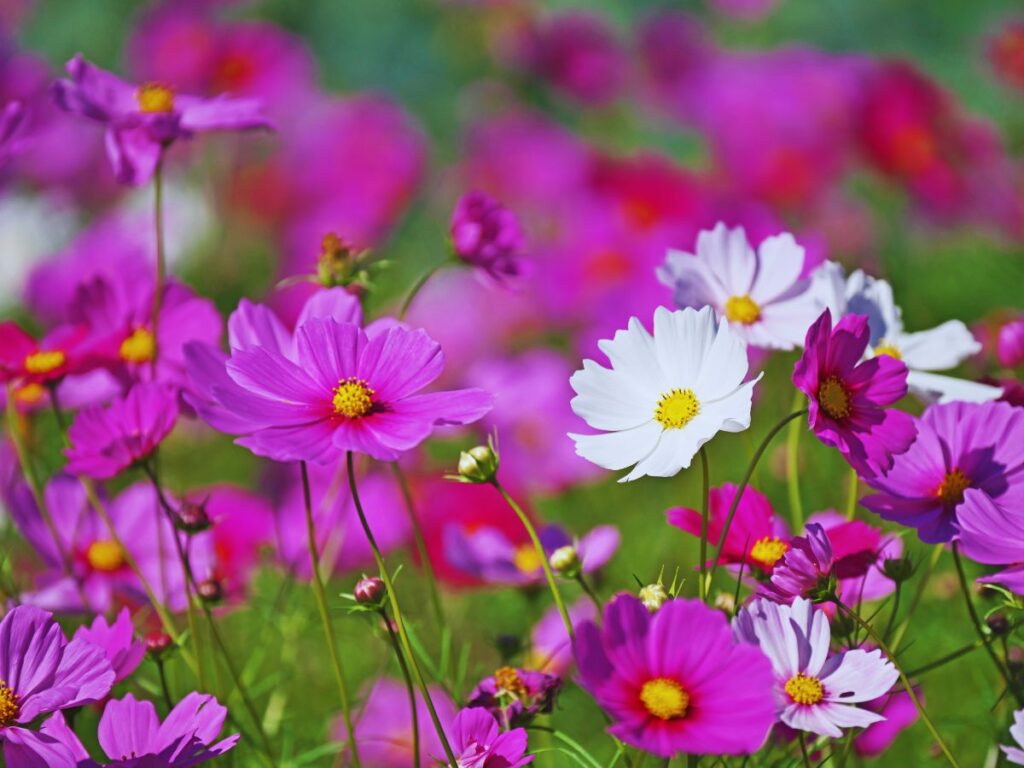
This park makes for a full day trip as well, and one I’d highly recommend to families with kids. The cosmos fields sit next to the park’s small zoo and playground. Over a million cosmos bloom on Flower Hill from early to late October. Depending on how the temperatures have been that year, the rose garden nearby can also still have blooms that late in the season.
- Getting there: Take the JR Kagoshima Line from Hakata Station to Kashii, then the JR Kashii Line to Uminonakamichi Station, right at the park entrance.
- Entry fee: 450 yen for high school age and older, 210 yen for 65 years old and over.
- Location: Uminonakamichi Seaside Park on Google Maps
Farm Tomita
Cosmos in Hokkaido run on a completely different schedule. At Farm Tomita in Furano, cosmos bloom alongside lavender and poppies from August into September, months before anywhere else in the country gets started. It’s less a dedicated cosmos trip and more a nice surprise tucked among a dozen other flower fields, worth the extra half hour if you’re already up there chasing lavender.
- Getting there: Take the JR Furano Line to Nakafurano Station, or the seasonal Furano-Biei Norokko train, which stops within a five-minute walk of the farm during summer.
- Entry fee: Free, including parking.
- Location: Farm Tomita on Google Maps
Cosmos aren’t the only thing that changes with the season…wagashi does too, with seasonal shapes and flavours like chestnut and sweet potato taking over from October. Try your hand at making your own in a hands-on wagashi workshop.
FAQs About Cosmos in Japan
When is the best time to see cosmos in Japan?
Hokkaido blooms first, from August into September. Everywhere else, early October through early November covers most fields, with peak bloom usually landing mid-to-late October.
Where can I see cosmos near Tokyo?
Hitachi Seaside Park is the big one, but Showa Kinen Park works better if you’re short on time.
Do locals actually visit cosmos fields, or is it mostly tourists?
Locals do turn up to popular cosmos fields in numbers, but the atmosphere feels much calmer than cherry blossom season. I’d count cosmos as one of the must-see flowers in Japan.
Can I see cosmos and autumn leaves together in Japan?
Several spots manage it. Showa Kinen Park, for example, pairs cosmos with ginkgo trees turning gold from mid-October.