

It’s no secret that there are a lot of earthquakes in Japan. The country sits where several tectonic plates meet, and although it covers just 0.28% of the world’s land area, it was the site of 18.5% of the world’s earthquakes of magnitude 6 or greater, according to Japan’s 2014 white paper on disaster management. Most of the time these are small tremors, so subtle you might think you’re imagining it (until you notice the curtains or the clothes on your hangers swaying).
Japan also has a history of devastating quakes. The one most people remember is the Great East Japan Earthquake, the magnitude 9.0 quake that struck off the Tohoku coast at 14:46 on 11 March 2011. It set off a huge tsunami and a meltdown at the Fukushima Daiichi nuclear power station, a triple disaster. As of March 2026, the National Police Agency counted 15,901 deaths, with 2,519 people still missing. Including people who died later from illness and the strain of evacuation, the Reconstruction Agency puts the number of deaths at 19,765.
Big earthquakes have kept coming since then. These are the major ones of the last few years, newest first:
| Date | Where | Magnitude | What happened |
|---|---|---|---|
| 28 July 2026 | Kumamoto Prefecture, Kyushu | 7.1 | Shindo 7 shaking; 39 deaths confirmed as of 10 August |
| 20 April 2026 | Off the Sanriku coast, northeast Japan | 7.7 | Tsunami warning and a week-long advisory for a possible follow-up quake |
| 8 December 2025 | Off Aomori Prefecture | 7.5 | Shindo 6 Upper and the first-ever Hokkaido and Sanriku “subsequent earthquake advisory” |
| August 2024 | Off Miyazaki Prefecture | 7.1 | Japan’s first Nankai Trough “megaquake advisory” |
| 1 January 2024 | Noto Peninsula, Ishikawa Prefecture | 7.6 | 581 deaths in Ishikawa, including deaths linked to evacuation |
You’ll often hear people say Japan is due for another big one, and the official forecasts agree. In September 2025, the government’s Earthquake Research Committee put the chance of a Nankai Trough megaquake off the Pacific coast within the next 30 years at 60–90% or more, with a second calculation method giving 20–50%. For Tokyo, the government puts the chance of a magnitude 7 quake directly beneath the capital at 70% over the same period.
As someone who didn’t grow up with earthquakes, I find those numbers unsettling. Knowing what to do takes a lot of the fear out of it, though, so here’s how alerts work, what to do when the shaking starts, and how to put together an emergency kit.
How Earthquake Alerts Work in Japan
Magnitude vs shindo
Japanese news reports give two numbers for every quake. Magnitude is the energy released at the source, so each earthquake has one. Shindo (震度) is the Japan Meteorological Agency’s (JMA) seismic intensity scale, which measures how hard the ground shakes in a particular place, so the same quake can be a 6 in one town and a 2 a few hours’ drive away. The scale has 10 levels: 0 to 4, then 5 Lower, 5 Upper, 6 Lower, 6 Upper, and 7.
Here’s roughly what the upper levels feel like, according to the Tokyo Intercultural Portal Site:
| Shindo | What it feels like |
|---|---|
| 4 | Most people find the shaking alarming |
| 5 Lower | Most people find the shaking frightening |
| 5 Upper | It’s hard to walk without holding on to something |
| 6 Lower | It’s hard to stay standing |
| 6 Upper | Standing is impossible, and people may be knocked over |
| 7 | Standing is impossible, and many buildings may lean or collapse |
From around 5 Lower, gas meters with safety devices automatically cut off the gas, and elevators with earthquake sensors stop for safety checks. Water and power cuts can start around the same level.
Immediately move away from any windows, as the glass is prone to shattering. Open the door in case it gets damaged while closed, which could prevent you from opening it later. Finally, get under a sturdy table to protect yourself from falling objects. In a worst-case scenario, even a blanket can offer some protection from debris.
Earthquake Early Warnings
When a strong earthquake is on its way, phones in the affected area sound a loud alarm: the Earthquake Early Warning (緊急地震速報, kinkyu jishin sokuho). When I say loud, I mean loud. A recorded message in Japanese tells you an earthquake is coming. The JMA says the gap between the warning and the strong shaking can be anywhere from a few seconds to a few tens of seconds, and places close to the epicentre may not get the warning before the shaking arrives.
Use those seconds to get away from anything that could fall and to protect your head. If the ground is already moving, don’t wait for an alarm.

What to Do During an Earthquake in Japan
If you’re indoors
Protect yourself first. The Tokyo Metropolitan Government’s survival manual says strong shaking usually lasts about a minute, so get under a sturdy table or desk and cover your head. Stay away from windows if you can get clear quickly, since the glass can shatter. In a worst-case scenario, even a blanket or pillow over your head offers some protection from debris.
Resist the urge to run outside while it’s shaking. Falling glass, roof tiles, and signs make the street more dangerous than staying put, and Shinjuku City’s earthquake guide tells people not to rush out in a panic.
Once the shaking eases, open the door. In concrete apartment buildings, a strong quake can warp the door frame and trap you inside, so the same manual recommends opening the door to secure a way out. If you’re in the bath or shower when it hits, protect your head with a washbowl and get out of the bathroom as soon as you can, according to the Tokyo government’s Disaster Readiness Guide.
If you were cooking, don’t lunge for the stove mid-quake. The gas cuts out automatically at around shindo 5 Lower, so turn off any flames once it’s safe to move.
If you’re Outdoors
Keep your head covered with a bag or whatever’s to hand, and move away from concrete block walls, windows, and signboards, which the survival manual flags as the main risks outside. Head for an open space or a sturdy building nearby.
If you’re in an elevator
As mentioned above, elevators with earthquake sensors stop automatically at around 5 Lower, and the JMA notes that service may not resume until safety has been confirmed, so be ready to use the stairs.
Stay where you are until the shaking has completely stopped, and expect aftershocks. After the July 2026 Kumamoto earthquake, more than 200 aftershocks were recorded in the first 24 hours.
If You’re Near the Coast: Tsunami Warnings
Many of the biggest earthquakes in Japan happen offshore, so if you’re at the beach or staying by the sea, the tsunami risk matters more than the shaking. Don’t wait for an official warning. The JMA says tsunamis can arrive before warnings are issued when the source is close to the coast, so head for high ground as soon as you feel strong shaking, or even weak shaking that goes on for a long time.
The JMA uses three levels of alert, set out in its tsunami warning leaflet:
| Alert | Expected tsunami height | What to do |
|---|---|---|
| Major Tsunami Warning | Over 3 metres | Evacuate immediately to high ground or a tsunami evacuation building |
| Tsunami Warning | 1 to 3 metres | Evacuate immediately to high ground or a tsunami evacuation building |
| Tsunami Advisory | 20 centimetres to 1 metre | Get out of the water and leave the coast |
A few rules from the JMA’s tsunami safety leaflet are worth remembering. Evacuate on foot so you don’t get stuck in traffic, and keep climbing to the highest ground you can reach. Tsunami waves hit repeatedly, and the first isn’t always the biggest, so stay put until the warning has been lifted. On beaches, a tsunami flag is also used to signal a warning, so if you see one, leave straight away.
After the Shaking Stops
Gas, power, and toilets
If you need to leave your home or hotel room, the Tokyo Fire Department advises switching off the circuit breaker and closing the main gas valve first, because damaged wiring can start fires when the power comes back on. If the gas has cut out and the meter’s red light is blinking, you can usually reset it yourself once you’re sure nothing is leaking.
Hold off on flushing the toilet. Minato City’s earthquake checklist says not to flush or drain water right after a major quake, since damaged pipes can make waste back up, and in apartment buildings it can overflow into the floors below. That’s where emergency toilet bags come in (more on those in the kit section below).
Evacuation sites vs evacuation shelters
Japan has two kinds of places to go, and the signs can look similar. An evacuation site (避難場所, hinan basho) is somewhere to flee to when there’s immediate danger, usually a park or schoolyard. An evacuation shelter (避難所, hinanjo) is a building, often a school gym or community centre, where you can stay if your home is damaged.
Shelters are free and open to anyone, tourists included. Check in at the reception desk when you arrive, and you’ll be given food, water, and blankets as supplies come in. It still helps to bring your own supplies. You don’t always need to leave. If your building is earthquake-resistant and undamaged, the Tokyo government encourages people to shelter at home instead.
To find your nearest evacuation site or shelter in Tokyo, check the Tokyo Disaster Prevention Map, which has machine translation into English, Chinese, and Korean. Outside Tokyo, search your city’s website for “evacuation centre” or “hinanjo” plus the city name, or check the Safety tips app (more on that below)
Getting in touch with family and friends
Phone lines can get jammed after a big quake, so Japan has a few backups:
- Disaster Emergency Message Dial (171): NTT’s voice message service lets you record a message linked to a phone number for others to play back. The voice guidance is only in Japanese, and the service works only within Japan.
- web171: The online version of 171, which family overseas can check too.
- 00000JAPAN Wi-Fi: After major disasters, Japan’s mobile carriers open their Wi-Fi spots for free under the network name “00000JAPAN”, and foreign visitors can use it too. It’s an open network, so don’t enter card details or passwords on it.
Apps and Resources to Prepare for Earthquakes in Japan
You don’t need to read Japanese to get official alerts. Download at least one of these apps before your trip (or as soon as you move here), and save the hotline number in your phone.
In a life-threatening emergency, call 110 for the police or 119 for an ambulance or the fire service. Both are free and run 24 hours a day.
| Resource | What it does | Languages |
|---|---|---|
| Safety tips app | Free app supervised by the Japan Tourism Agency. Push alerts for Earthquake Early Warnings, tsunami warnings, and weather warnings, plus evacuation and shelter information and a list of hospitals that accept foreign patients | English, Japanese, Korean, Traditional Chinese, Simplified Chinese, Vietnamese, Spanish, Portuguese, Thai, Indonesian, Tagalog, Nepali, Khmer, Burmese, and Mongolian |
| NHK WORLD-JAPAN app | The public broadcaster’s international app. Push alerts for earthquakes, tsunamis, and severe weather, plus English news | English, Traditional Chinese, Simplified Chinese, Portuguese, Vietnamese, French, Hindi, Indonesian, Korean, Russian, Spanish, and Thai |
| Disaster Preparedness Tokyo app | The Tokyo Metropolitan Government’s app. Disaster guides, evacuation information, and details of temporary facilities for people who can’t get home | English, Japanese, Korean, Traditional Chinese, and Simplified Chinese |
| Japan Visitor Hotline | 24-hour phone line run by the Japan National Tourism Organization (JNTO) for emergencies, including disasters. Call 050-3816-2787 in Japan or +81-50-3816-2787 from overseas | English, Chinese, and Korean |
| Japan Safe Travel on X (@JapanSafeTravel) | JNTO’s account for disaster warnings and travel updates | English and Chinese |
Preparing an Emergency Kit for Earthquakes in Japan
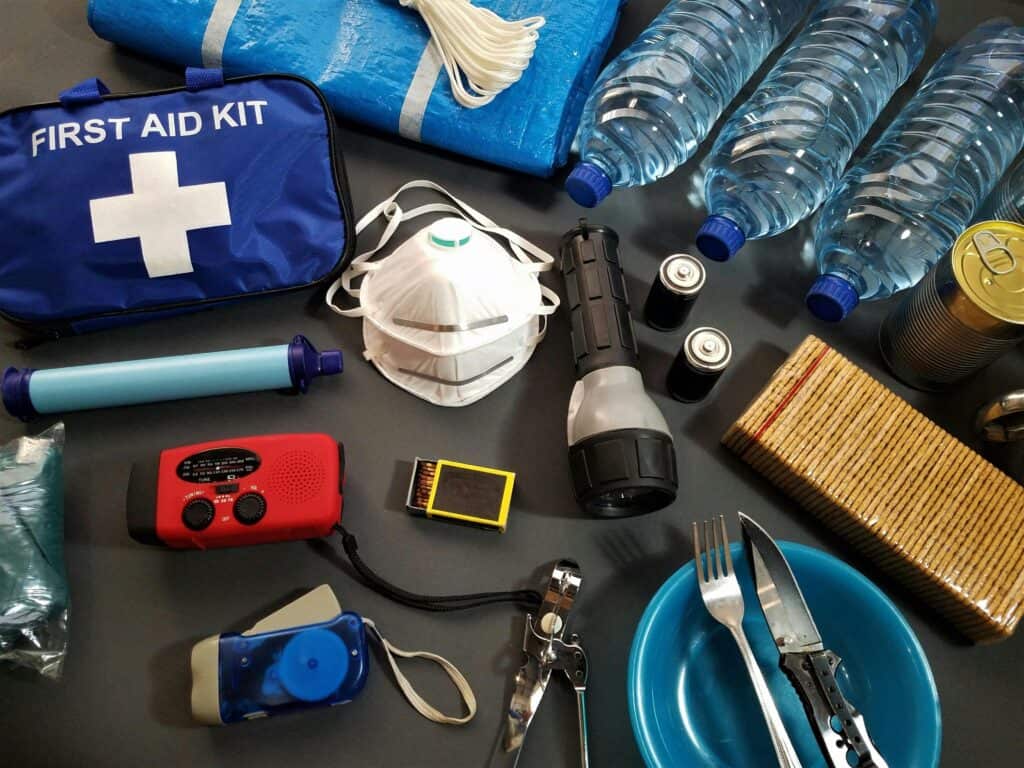
In worst-case scenarios, the power may go out, and water supplies could be disrupted. After the 2026 Kumamoto earthquake, for example, Kumamoto Prefecture reported more than 45,000 homes still without water six days later. Putting together an emergency kit isn’t expensive, and it doesn’t take up much space in your home.
Kits vary depending on your health needs, diet, and household, but here are the basics, based on the Tokyo Intercultural Portal Site‘s stockpiling guide unless noted otherwise:
- Water: Plan on 3 litres of drinking water per person per day, for at least three days and ideally a week. For one person, that’s 9 to 21 litres, or six to 14 of those 1.5-litre bottles. Keep extra water for washing in large bottles, or keep the bath filled.
- Non-perishable food: At least three days’ worth, a week if possible. Canned food, cup noodles, retort pouches, and alpha rice (which only needs water) all work. Go for cans with ring pulls so you don’t need a can opener.
- Emergency toilet bags: The government suggests about five per person per day, so 35 for a week. Add toilet paper and tissues too; as we learned in the pandemic, toilet paper is one of the first things to sell out in a crisis.
- Helmet: Many sources recommend keeping a safety helmet at home to protect your head from falling debris.
- Important Documents/Items: Gather your passport, residence card, insurance card, hanko stamp, keys, and any other documents that would be difficult to replace.
- Flashlight and power: A flashlight, spare batteries, and a portable battery pack for your phone. A radio is useful too.
- Medication: A supply of any medicine you take regularly.
- Shoes or slippers by your bed: So you can walk over broken glass if the quake hits at night.
- Portable gas stove: A camping stove and gas canisters let you heat food if the gas is off.
These are just the basics, but having them on hand will make you feel much safer and better prepared.
Why You Need to Be Prepared for Earthquakes in Japan
If you’re in Japan long enough, you’re bound to feel an earthquake. Most will pass in a few seconds and leave nothing more than a rattled shelf. If a big one does hit, stay calm and follow the instructions from local authorities, your accommodation, or your embassy, and keep an eye on the apps above for updates in English.
Not sure where to start with your Japan trip? Book a free consultation call with one of our expert planners.